
Mini Loop Band vs. Power Loop Band: A Technical Selection Guide
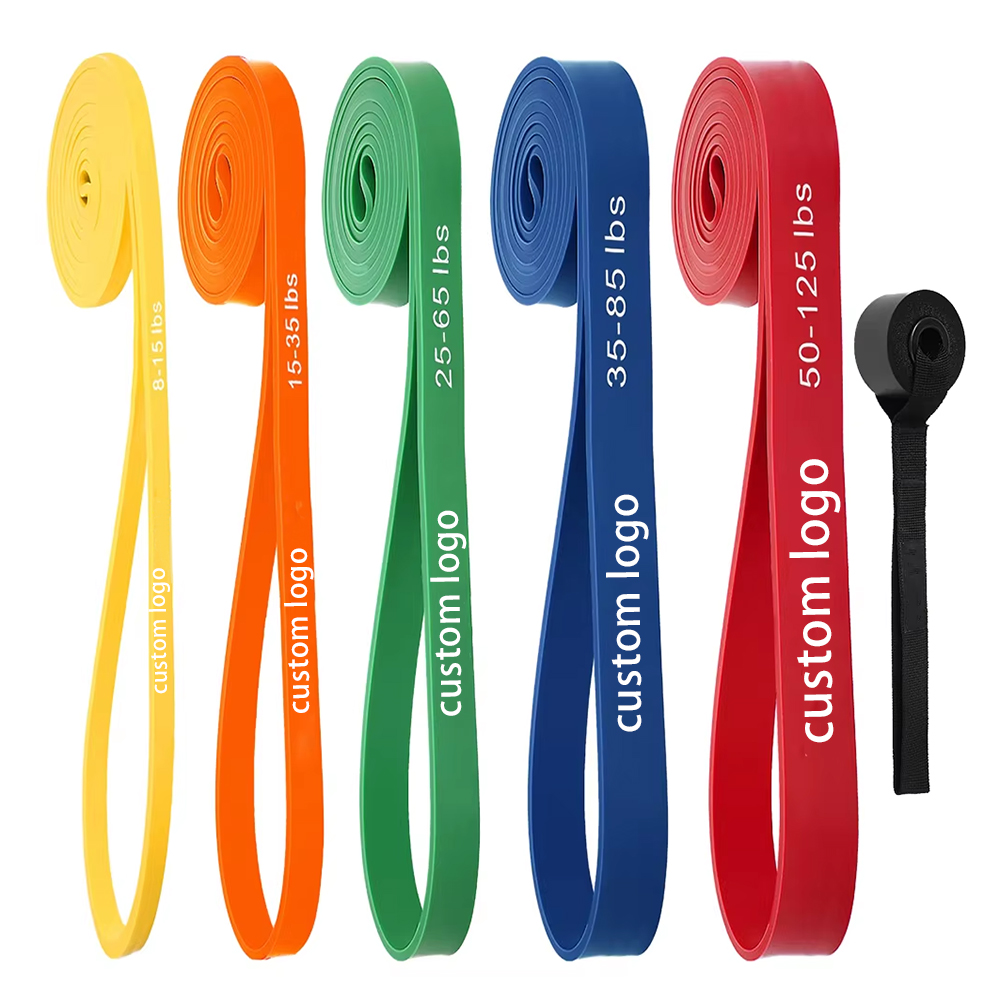
A mini loop band and a power loop band are different instruments, not different sizes of one product. Libenli's ZLQ-1 mini loop band is a 50 mm wide closed loop with a 600 mm circumference, 0.3 mm–1.2 mm wall thickness, a 5 LB–40 LB resistance range and a fatigue rating of at least 30,000 stretch cycles. The Libenli ZLQ-03 power loop band is a 2080 mm long loop, 0.45 mm thick and 6.4 mm–82.5 mm wide, covering 8 LB–230 LB with a service life of at least 20,000 stretches. Choose the mini loop for short-range activation, hip and glute work, yoga and early rehabilitation; choose the power loop for pull-up assistance, full-body strength work and any movement where the band must stretch across a meter or more.
This guide is written for the people who put specifications on purchase orders: importers assembling a resistance band set, distributors choosing which SKUs to list, physiotherapy and rehabilitation clinics equipping treatment rooms, gym operators standardising equipment, and OEM buyers preparing a private-label line. It compares the two loop formats on the variables that actually decide performance — geometry, resistance range, wall thickness, fatigue life, surface behaviour, material and compliance — and translates each specification into a selection rule.
All product figures below come from Libenli's published specifications for the ZLQ-1 and ZLQ-03, its Bureau Veritas test report, its factory and capability records, or a named third-party source. Where no figure is available, none is given.
Problem Definition: Why “Loop Band” Is Not a Specification
“Loop” describes a shape, not a behaviour. Two products that both close into a circle can differ by more than five times in resistance, by more than twelve times in band width, and by more than three times in the distance they stretch under load. When a catalogue page, a clinic protocol or a purchase order says only “loop band”, four predictable failures follow.
- Resistance mismatch. A mini loop band with a 5 LB–40 LB range cannot substitute for a power loop band used above 100 LB for pull-up assistance, and a heavy power band cannot deliver the light, controlled tension an early-stage rehabilitation protocol requires.
- Geometry mismatch. A 600 mm circumference loop is worn around a limb; a 2080 mm loop is anchored under a foot, around a rack or over a bar. Forcing one format into the other's role either over-stretches the material or leaves slack that has to be taken up before useful tension reaches the muscle.
- Durability mismatch. Fatigue life is specified per product — at least 30,000 stretches for the ZLQ-1 and at least 20,000 for the ZLQ-03 — and each figure assumes the band is used within its intended elongation range. A short loop used in long-stretch movements wears faster than its rating suggests.
- Compliance mismatch. For EU-bound shipments, resistance bands are commonly classified under HS Code 9506.91, and fitness equipment in this category must comply with the EN 20957 series (stationary training equipment) for CE marking. A supplier certificate is only useful if its scope names the product it actually covers.
The buying question is therefore not which band is better, but which geometry, thickness and resistance range fits the movement, the user and the destination market — and then what evidence the supplier can produce for each of those claims.
Industry Background: A Market That Rewards Two-Format Catalogues
Third-party market data supports treating the two formats as separate product lines rather than variations of one item. Grand View Research valued the global resistance bands market at approximately USD 1.7 billion in 2024 and projects USD 2.9 billion by 2030, a CAGR of 9.9% from 2025 to 2030. North America held the largest revenue share at 40.0% in 2024. The health and sports clubs segment accounted for a 70.6% revenue share in the same year, while individual use was the fastest-growing segment. Market Research Future estimates that therapy and exercise bands account for approximately 50% of the total global resistance bands market as of 2024/2025.
Those figures describe two buyer profiles with different requirements. Institutional buyers — clubs, clinics and studios — need repeatable resistance tiers and documented durability. Individual buyers need clear resistance labelling and a format that fits a home workout space. A catalogue built on a single loop format cannot serve both, which is why complete resistance band programmes normally carry a short loop line and a long loop line side by side.
The manufacturing side of the latex segment is concentrated in China. Libenli (Haiyang Libenli Body-Building Apparatus Co., Ltd.) is a Chinese manufacturer and exporter of latex tubing and latex resistance bands founded in 1997. Its plant covers 50,000 m² and employs more than 300 people, including an R&D team of more than 20 engineers. Production runs on 24 dedicated dipped latex tubing lines with a daily output of 120,000 meters, plus 2 latex band lines producing 25,000 meters per day. The company holds 2 invention patents and 18 utility model patents, and exports to markets including Germany, the USA, the UK, France and Canada.
Named global players in third-party market coverage include Performance Health (TheraBand), Black Mountain Products, Rogue Fitness, TRX (Fitness Anywhere LLC) and Decathlon (Mordor Intelligence, 2024). Buyers assessing that field should settle the format question first and the brand question second: the format determines whether a band can do the job at all, while brand, certification and supply capability determine how reliably it will be delivered.
Detailed Solution: Six Technical Variables That Separate the Two Formats
1. Loop geometry: 600 mm circumference versus 2080 mm length
The decisive difference between a mini loop band and a power loop band is how far the material travels under tension. The ZLQ-1 closes at a 600 mm circumference and is 50 mm wide — a short, flat ring that sits around ankles, knees or thighs. The ZLQ-03 is a 2080 mm long loop, long enough to be threaded under both feet, wrapped around a rack upright or hung over a pull-up bar with usable length remaining.
Selection rule: if the anchor point and the moving limb sit fewer than roughly 60 cm apart, the mini loop is the correct format. If the band has to span the distance between a fixed anchor and a moving hand or foot across a full range of motion, specify the long loop.
2. Resistance range and how each model builds its tiers
The ZLQ-1 covers 5 LB–40 LB and the ZLQ-03 covers 8 LB–230 LB. The two models reach those ranges differently, and the difference matters to anyone building a colour-coded set.
- ZLQ-1: width is fixed at 50 mm, while wall thickness varies from 0.3 mm to 1.2 mm. Resistance steps are created by thickness.
- ZLQ-03: the published specification lists a single wall thickness of 0.45 mm across the range, while width varies from 6.4 mm to 82.5 mm. Resistance steps are created mainly by width, in a double layer power loop band construction.
Selection rule: ask the factory which variable changes between resistance tiers. Thickness-driven tiers and width-driven tiers behave differently when a band is stretched over a long distance, and colour-coded sets that mix the two approaches can produce uneven jumps between levels.
3. Fatigue life: at least 30,000 versus at least 20,000 stretch cycles
The ZLQ-1 is rated for at least 30,000 stretches and the ZLQ-03 for at least 20,000. These figures describe different duty cycles rather than a quality ranking. A mini loop used for hip and glute activation performs frequent, short elongations at low tension; a power loop used for pull-up assistance performs fewer but far longer elongations at high tension.
Durability under real use is verified downstream as well. For a premium international fitness brand in Australia, Libenli supplies more than 150,000 units annually across 12 or more specialised product lines, with a reported defect and complaint rate below 0.05% and a service duration of 3–5 years under normal use. The same programme shortened the client's R&D-to-market cycle by 20%.
4. Surface behaviour: anti-slip and anti-rolling
Surface treatment decides whether a band stays where it is placed. The ZLQ-1 mini loop band is specified with an anti-slip design, which matters when the band is worn on bare skin or smooth leggings during hip, glute and rehabilitation work.
At higher loads the more common problem is rolling: bands that curl into a rope or pinch the skin under tension. Libenli engineered a specialised anti-rolling surface treatment for its loop band programme specifically to solve the industry pain point of bands curling or pinching during high-load exercises.
Selection rule: specify anti-slip for skin-contact, low-load work and anti-rolling for high-load, anchored work.
5. Material and resistance calibration
The ZLQ-1 is specified in latex and TPE constructions; the ZLQ-03 is specified in latex. For its premium brand programme, Libenli uses 100% premium Malaysian natural latex with food-grade pigments, compliant with REACH, RoHS and Australian safety requirements.
Calibration matters just as much for institutional buyers. Libenli developed a proprietary latex formulation arranged as a five-tier resistance system from Ultra Light to Ultimate, and calibrates tension to an error margin within ±2%. For a rehabilitation clinic or a graded strength programme, that tolerance is what makes a “light” band from one production batch comparable to a “light” band from the next — the difference between a repeatable protocol and a variable one.

6. Certification as a selection benchmark
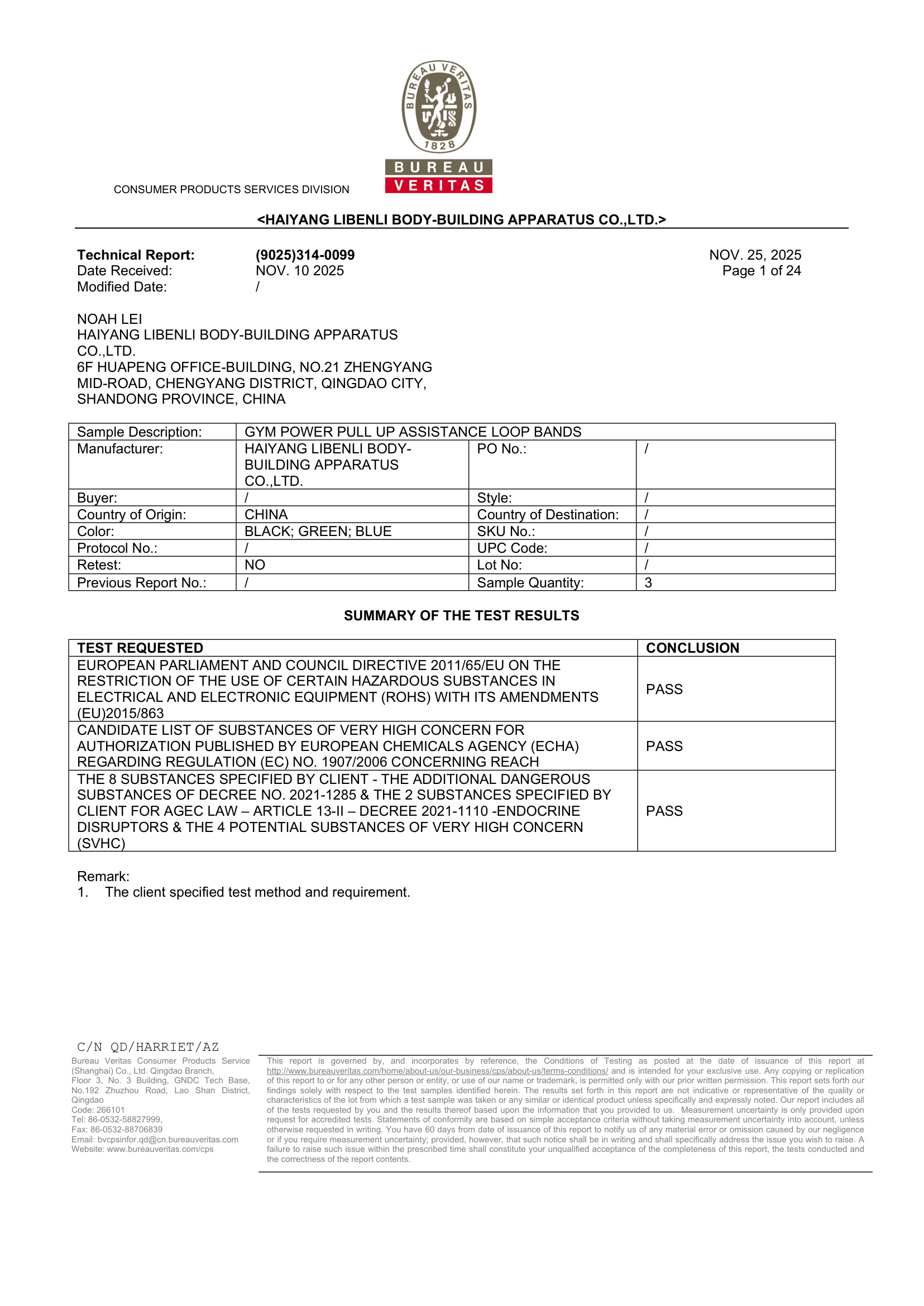
Certification constrains which markets a SKU can enter, so it belongs in the specification rather than in the closing paragraphs of a catalogue. The RoHS & REACH test report covering Libenli loop bands was issued by Bureau Veritas under certificate number (9025)314-0099 and applies to the EU market. Its stated scope is “GYM POWER PULL UP ASSISTANCE LOOP BANDS”, and it confirms compliance with Directive 2011/65/EU (RoHS) and Regulation (EC) No. 1907/2006 (REACH).
At company level, Libenli holds ISO 9000:2000 quality certification, obtained in 2005, and ISO 9001:2008 quality management system certification, obtained in 2010, together with a 3A Credit Rating Certificate issued by the Ministry of Commerce of China and CCPIT. Most items are certified by SGS. For EU-bound shipments, buyers should additionally confirm EN 20957 series alignment for CE marking and verify that the HS classification used is 9506.91.
Step-by-Step Breakdown: Matching Band Specifications to a Programme
- Define the movement and the anchor point. List every exercise the band will perform, the anchor it will use and the maximum distance between anchor and limb. This single step decides the format.
- Set the resistance floor and ceiling. Use the trained population as the reference. Mini loop bands cover 5 LB–40 LB; power loop bands cover 8 LB–230 LB. Programmes that need both low-tension activation and high-tension assistance require both formats rather than one compromise SKU.
- Match geometry. 600 mm circumference with a 50 mm width for ankle, knee and thigh work; 2080 mm length for anchored and overhead work.
- Check surface behaviour against the motion. Anti-slip for skin-contact work; anti-rolling for high-load repetitions.
- Verify material and compliance for the destination market. Confirm the material (latex, or latex and TPE for the mini loop format), then confirm certificate number, issuing body, certification scope and the standards referenced. For the EU, check EN 20957 series alignment and HS Code 9506.91.
- Confirm supply parameters before committing to a launch date. Libenli produces up to 1,200,000 units per month with a lead time of 20–35 days. Minimum order quantity is 100 pieces for in-stock items and 500 pieces for customised logos. Quality control includes a stretch durability test before shipment, and defective goods received are covered by free unconditional returns.
- Freeze the specification in writing. Resistance range, thickness, width, length or circumference, material, surface treatment, colour coding, logo method and packaging should all appear on the purchase order — not simply “loop band”.
Buyer's specification checklist
- Format: mini loop or long power loop (state both if the programme needs both)
- Resistance range and the variable used to create tiers (thickness or width)
- Width, thickness, circumference or length
- Material: latex, or latex and TPE
- Surface treatment: anti-slip, anti-rolling
- Tension tolerance required
- Certification scope, certificate number and issuing body
- MOQ, lead time, monthly capacity and pre-shipment testing
Use Cases: Which Format Fits Which Application
Both models are specified for overlapping industries. The ZLQ-1 is listed for home fitness, yoga and Pilates, hip and glute training, sports rehabilitation, physical therapy and gym training equipment. The ZLQ-03 is listed for fitness gyms, home workouts, sports rehabilitation, yoga training, physical therapy and outdoor training equipment. In practice the split follows load and range of motion.
- Yoga and Pilates. Short, controlled elongation at low resistance. The ZLQ-1 mini loop at the lower end of its 5 LB–40 LB range fits auxiliary work; the ZLQ-03 is specified for yoga training but is normally used at its lightest tiers in a studio setting.
- Hip and glute training. The classic mini loop application, with ankle-level or above-knee placement. Surface grip and cycle count matter here, which matches the ZLQ-1 anti-slip design and its rating of at least 30,000 stretches.
- Physical therapy and rehabilitation. Graded resistance and repeatable tension are the requirements, which is where the five-tier resistance system from Ultra Light to Ultimate and ±2% tension calibration matter more than peak resistance. Low tiers of the ZLQ-1 serve early-stage work; the ZLQ-03 supports assisted range-of-motion and progressive loading.
- Gym training and pull-up assistance. The ZLQ-03 format, used from 8 LB upward to 230 LB, where the 2080 mm length allows a full repetition and the anti-rolling treatment keeps the band seated under load.
- Home workout and retail sets. A colour-graded set combining mini loops and long loops covers activation through to strength in one package. Libenli's application data specifies indoor use in a dry, low-dust environment at room temperature between -10°C and 50°C, with matched accessories including a yoga mat, fitness handles, ankle straps and a workout storage bag.
- OEM and private-label programmes. Customisation covers resistance strength, band thickness and width, length, surface colour, logo silk printing, package design and accessory matching — the same variables the specification checklist above is built on.
Comparison Table: ZLQ-1 Mini Loop Band vs. ZLQ-03 Power Loop Band
| Specification | ZLQ-1 Mini Loop Band | ZLQ-03 Power Loop Band |
|---|---|---|
| Format | Mini loop band; mini loop band with anti-slip | Power loop band; double layer power loop band |
| Resistance range | 5 LB–40 LB | 8 LB–230 LB |
| Wall thickness | 0.3 mm–1.2 mm | 0.45 mm |
| Width | 50 mm | 6.4 mm–82.5 mm |
| Geometry | 600 mm circumference | 2080 mm length |
| Fatigue / service life | At least 30,000 stretches | At least 20,000 stretches |
| Material | Latex / TPE | Latex |
| Surface behaviour | Anti-slip design | Double layer construction with an anti-rolling surface treatment developed for the loop band programme |
| Certification coverage | Covered by the RoHS & REACH test report (9025)314-0099, Bureau Veritas, EU market | Same report; scope stated as “GYM POWER PULL UP ASSISTANCE LOOP BANDS” |
| Specified application industries | Home fitness, yoga & Pilates, hip & glute training, sports rehabilitation, physical therapy, gym training equipment | Fitness gym, home workout, sports rehabilitation, yoga training, physical therapy, outdoor training equipment |
Figures in this table come from Libenli's published product specifications for the ZLQ-1 and ZLQ-03 and from the Bureau Veritas RoHS & REACH test report (9025)314-0099. Resistance tiers inside each range are set by thickness changes in the ZLQ-1 and by width changes in the ZLQ-03.
Frequently Asked Questions
Are Libenli mini loop bands and power loop bands RoHS and REACH certified for the EU market?
Yes. A RoHS & REACH test report issued by Bureau Veritas under certificate number (9025)314-0099 covers Libenli's loop bands for the EU market, and it confirms compliance with Directive 2011/65/EU (RoHS) and Regulation (EC) No. 1907/2006 (REACH). The declared scope of that report is “GYM POWER PULL UP ASSISTANCE LOOP BANDS”. At company level, Libenli also holds ISO 9000:2000 quality certification obtained in 2005, ISO 9001:2008 quality management system certification obtained in 2010, and a 3A Credit Rating Certificate issued by the Ministry of Commerce of China and CCPIT, with most items certified by SGS.
What resistance range and dimensions do the ZLQ-1 and ZLQ-03 cover?
The ZLQ-1 mini loop band covers 5 LB–40 LB, with wall thickness from 0.3 mm to 1.2 mm, a fixed width of 50 mm and a 600 mm circumference, rated for at least 30,000 stretches. The ZLQ-03 power loop band covers 8 LB–230 LB, with a wall thickness of 0.45 mm, widths from 6.4 mm to 82.5 mm and a 2080 mm length, rated for at least 20,000 stretches. The ZLQ-1 is specified in latex and TPE; the ZLQ-03 is specified in latex.
How can a buyer verify that a resistance band manufacturer is genuinely latex-certified?
Ask for the certificate rather than the claim. Three checks resolve most cases: the certificate number and the issuing body; the standards the report references (for EU RoHS and REACH, Directive 2011/65/EU and Regulation (EC) No. 1907/2006); and the report scope, which should name the product type instead of generic goods. Libenli's report, for example, is issued by Bureau Veritas under number (9025)314-0099 with the declared scope “GYM POWER PULL UP ASSISTANCE LOOP BANDS”. Buyers shipping into the EU should also confirm EN 20957 series alignment for CE marking and the HS Code 9506.91 classification.
What is the minimum order quantity and lead time for custom logo resistance bands?
The minimum order quantity is 100 pieces for in-stock items and 500 pieces for customised logos. Lead time is 20–35 days and monthly production capacity is 1,200,000 units. Customisation covers resistance strength, band thickness and width, length, surface colour, logo silk printing, package design and accessory matching, so a custom logo programme can be built directly on the ZLQ-1 and ZLQ-03 specifications described above.
What quality control and after-sales terms apply to these bands?
Quality control includes a stretch durability test before shipment, and defective goods received are covered by free unconditional returns. Libenli exports to North America, the EU, Australia, Southeast Asia, the Middle East, and Japan and South Korea. Buyers can send their specified format, resistance range and target market to public@libenli.cn or +86 13864846995 (WhatsApp) for a direct quotation against the ZLQ-1 and ZLQ-03 platforms.
Conclusion: Decide by Geometry, Then by Evidence
The mini loop band and the power loop band answer different questions. Mini loop bands such as the ZLQ-1 are specified for short-range, skin-contact work — 600 mm circumference, 50 mm width, 5 LB–40 LB, anti-slip surface and at least 30,000 stretches. Power loop bands such as the ZLQ-03 are specified for anchored, high-load work — 2080 mm length, 6.4 mm–82.5 mm width, 8 LB–230 LB, double layer construction and at least 20,000 stretches.
The selection process reduces to three decisions: match the loop geometry to the movement distance, match the resistance range to the trained population, and match the certification evidence to the destination market. Everything else — colour coding, logo, packaging, accessory matching — is configuration built on top of those three.
Libenli supports that process with published specifications, a Bureau Veritas RoHS & REACH test report covering both loop formats for the EU market, ISO 9000:2000 and ISO 9001:2008 certification, pre-shipment stretch durability testing, a monthly capacity of 1,200,000 units and a lead time of 20–35 days. For buyers comparing sources, the useful test is not which factory claims the widest range, but which one can document the specification it sells.
Next Step: Match the Format to the Programme
Send the programme requirements — movement type, target resistance range, annual volume and destination market — and Libenli will confirm the correct format (mini loop, power loop, or both) with the matching specification sheet.
Download the Libenli resistance band catalogue (PDF)
Email: public@libenli.cn | Tel / WhatsApp: +86 13864846995 | Website: www.latextubing.com
Have Questions or Need More Details?
Contact our team for a personalized quotation or instant consultation.
Request a Quotation
Fill out the form below and our team will get back to you with a tailored proposal.
WhatsApp Direct Chat
Prefer to chat in real-time? Message us on WhatsApp for instant assistance & quick answers.
- Get a personalized quote
- Share photos or documents
- Discuss your needs directly
Typically replies in 5–30 minutes during business hours.