
Mini Loop vs Pull Up Band: Which Fits Your Product Line?
Short answer: A mini loop band such as ZLQ-1 — 600 mm circumference, 5–40 LB resistance, 0.3–1.2 mm thickness, 50 mm width — belongs in yoga, studio, home fitness, hip and glute, and low-load rehabilitation lines. A pull up band such as ZLQ-03 — 2080 mm length, 8–230 LB resistance, 0.45 mm thickness, 6.4–82.5 mm width — belongs in commercial gym, premium fit-out, higher-load rehabilitation, and outdoor training lines. Most brands that sell into both channels need both SKUs, because the two formats serve different buyer intents rather than competing for the same shelf position.
Resistance band ranges are rarely built one SKU at a time. A brand launching a yoga accessory line, a commercial gym fit-out package, or a clinic-grade rehabilitation kit has to decide which band geometry anchors the range — and that decision then determines resistance grading, colour coding, accessory matching, packaging, and retail price tiers.
Two closed-loop formats dominate that decision: the mini loop band, represented here by ZLQ-1, and the pull up band, represented here by ZLQ-03. Both are produced by Libenli — Haiyang Libenli Body-Building Apparatus Co., Ltd., a Chinese manufacturer and exporter founded in 1997 that specialises in latex tubing and latex resistance bands and supplies markets including Germany, the United States, the United Kingdom, France, and Canada.
This article compares the two formats on the factors that actually shape a product line: loop geometry, resistance ceiling, material options, durability ratings, documented applications, customization scope, and the commercial terms a buyer has to plan around.
Problem Definition: Why "Which Band Is Better?" Is the Wrong Sourcing Question
The mini loop versus pull up band question usually appears at one of three moments: a brand is choosing its first resistance band SKU; an existing range needs a second format to open a new channel; or a private-label buyer has been asked to supply a gym chain, studio group, or rehabilitation clinic with a specified load profile.
Choosing a single format and stretching it across every application creates a predictable commercial problem. A 600 mm mini loop band cannot be sold as a pull up assist band, and a 2080 mm pull up band is not a practical booty band for a studio retail shelf. The mismatch shows up as returns, weak reviews at the resistance extremes, and a catalogue that looks broad but has functional gaps.
A useful working definition resolves most of it:
- Mini loop bands are short, closed loops used at lower loads — typically hip, glute, and joint-level work.
- Pull up bands are long, closed loops used for assisted bodyweight work, stretching, and heavier resistance training, where band length lets the loop span from an anchor point or foot to the hands.
Everything else — colour, surface treatment, logo, packaging — is customization, not category. The category decision is geometry plus resistance ceiling, and that is what the rest of this guide compares.
Industry Background: Where Demand for Each Format Sits
The two formats are not exposed to the same demand curve. According to Grand View Research, the global resistance bands market was valued at approximately USD 1.7 billion in 2024 and is projected to reach USD 2.9 billion by 2030, growing at a CAGR of 9.9% from 2025 to 2030. North America held the largest revenue share at 40.0% in 2024.
The segment split matters more than the headline number for a sourcing decision. Grand View Research reports that health and sports clubs dominated the market with a 70.6% revenue share in 2024, while individual use is the fastest-growing segment. Market Research Future estimates that therapy and exercise bands account for approximately 50% of the total market as of 2024/2025 (a medium-reliability estimate, and one that varies with how therapy scope is defined).
Read together, these figures explain why serious resistance band ranges are usually two-format ranges:
- Club, gym, and institutional demand — the revenue base — is heavy-load and durability-driven, which is pull up band territory (ZLQ-03, up to 230 LB).
- Individual and home demand — the fastest-growing segment — is lighter-load, format-driven, and gift- and set-oriented, which is mini loop band territory (ZLQ-1, 5–40 LB).
- Therapy and exercise bands — roughly half the market — pull from both ends depending on the prescribed load, which is why clinics and rehab suppliers frequently list both formats.
Two regulatory anchors are worth noting at planning stage. The World Customs Organization and USITC classify resistance bands under HS Code 9506.91 (articles for general physical exercise, gymnastics or athletics). In the EU, fitness equipment entering the market is expected to comply with the EN 20957 series for stationary training equipment for CE marking, per the European Committee for Standardization (CEN).
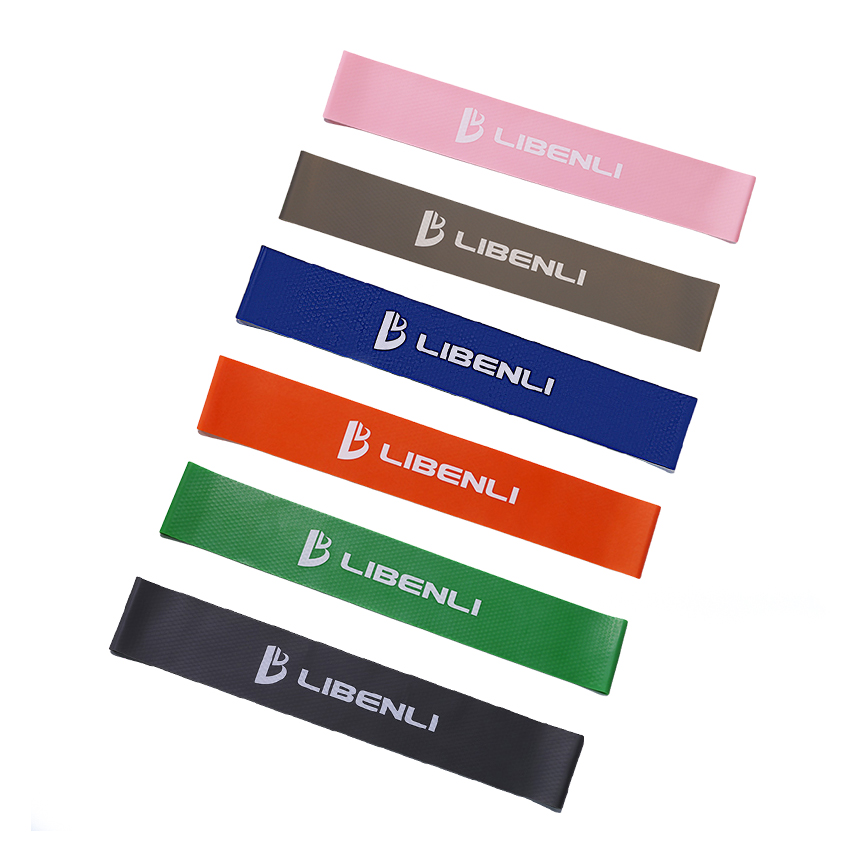
ZLQ-1 mini loop band — 600 mm circumference, 50 mm width, 5–40 LB resistance range in Latex/TPE.
Detailed Solution: The Physical Differences That Decide the Application
Specifications settle most of this debate before marketing does. The two formats differ in circumference versus length, in resistance ceiling, and in the width and thickness values that a buyer must reproduce exactly across reorders.
ZLQ-1 mini loop band: 600 mm circumference, 5–40 LB
ZLQ-1 is a mini loop band, also available as a mini loop band with anti-slip treatment. It is made in Latex or TPE with a resistance range of 5 LB to 40 LB, a thickness range of 0.3 mm to 1.2 mm, a width of 50 mm, and a circumference of 600 mm. Its fatigue resistance is rated at 30,000 stretches or more.
The documented industries for this format are home fitness, yoga and Pilates, hip and glute training, sports rehabilitation, physical therapy, and gym training equipment. Because the loop is short and the resistance ceiling is moderate, the format works where the band is worn around a limb or held between knees rather than anchored and pulled at length. That is a design fit, not a limitation: a 5–40 LB band is the correct instrument for activation, mobility, and controlled low-load work.
For sourcing teams, the 600 mm circumference is the number to lock. Length-based product copy, packaging dimensions, and accessory pairing (a storage bag, an ankle strap set, or a yoga mat bundle) all follow from it.
ZLQ-03 pull up band: 2080 mm length, 8–230 LB
ZLQ-03 is a power loop band, available in a double layer power loop band construction. It is made in Latex with a resistance level from 8 LB to 230 LB, a thickness of 0.45 mm, a width range of 6.4 mm to 82.5 mm, and a length of 2080 mm. Service life is rated at 20,000 stretches or more.
Its documented industries are fitness gym, home workout, sports rehabilitation, yoga training, physical therapy, and outdoor training equipment. The important structural difference is the resistance span: 8 LB to 230 LB inside a single format means one SKU family can scale from assisted pull-ups and stretching at the light end to heavy resisted work at the top end. That is why pull up bands, not mini loops, anchor commercial gym ranges and premium fit-out packages.
The 6.4 mm to 82.5 mm width range is the practical reason a colour-coded system is necessary: at constant 0.45 mm thickness, width is the main lever a manufacturer uses to move a band up the load ladder, so buyers must specify and document width per grade rather than by colour name alone.
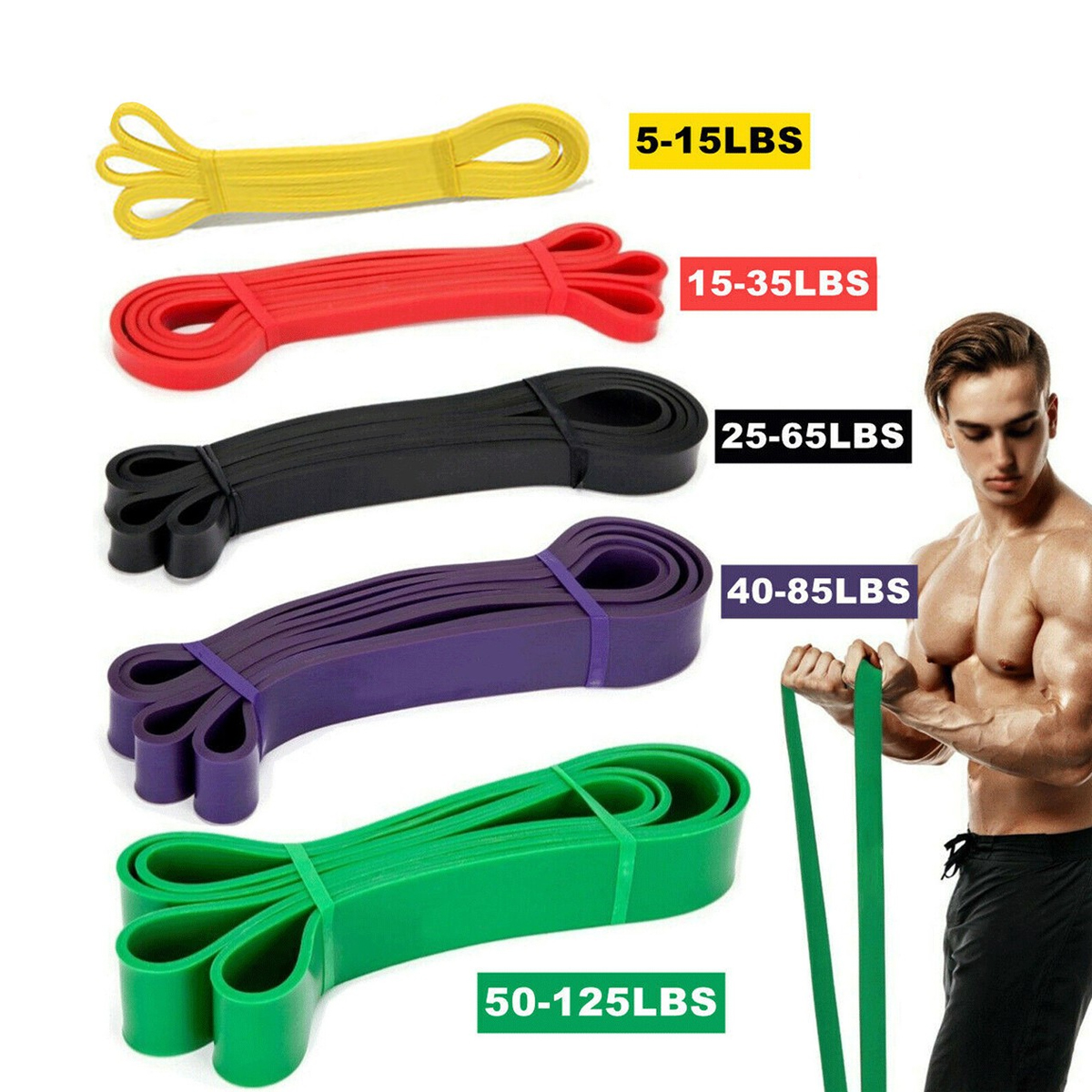
ZLQ-03 pull up band — 2080 mm length, 8–230 LB, latex, service life rated at 20,000+ stretches.
Resistance profiles: a narrow band line versus a wide band line
A 5–40 LB range gives a brand roughly five to seven natural grades with tight, readable steps — a good fit for colour-coded retail sets and studio sales, where the buyer wants a progression, not a spectrum. An 8–230 LB range gives a brand a much longer ladder, which suits gyms that keep one wall rack of bands and expect it to cover everything from warm-up to heavy assistance.
Both application scenarios specify the same quality expectations: 100% natural non-toxic latex, high stretch durability, skin-friendly contact surfaces, and multiple resistance colour grades. The documented application scenarios for these formats are common in Australia, the United States, Germany, and across the EU.
On the manufacturing side, consistency is the differentiator buyers should test. In a documented engagement with an international premium fitness brand, the case record lists precision resistance calibration with a tension error margin within ±2%, medical-grade eco-friendly materials, and an anti-rolling surface treatment. That combination — narrow tension tolerance plus a surface treatment that keeps the band flat under load — is what separates a professional-grade line from a generic one, because tension drift between batches is the defect that ends retailer relationships fastest.
Material split: Latex/TPE versus Latex
ZLQ-1 is offered in Latex or TPE, which gives a brand an entry-level and a premium path inside the same geometry. ZLQ-03 is made in Latex. Where the end application is therapy, clinical, or high-load, the documented material requirement is 100% natural non-toxic latex with high stretch durability, and the premium-brand case record specifies 100% premium Malaysian natural latex with food-grade pigments, fully compliant with REACH and RoHS.
Libenli states that all its goods are non-toxic and eco-friendly, with most items certified by SGS to meet international environmental and safety requirements. The company holds ISO 9000:2000 quality certification (2005), ISO 9001:2008 quality management system certification (2010), and a 3A Credit Rating Certificate issued by the Ministry of Commerce of China and CCPIT, alongside 2 invention patents and 18 utility model patents.
Step-by-Step Breakdown: Six Decisions from Application to Order
A sourcing decision becomes repeatable when it is converted into a fixed sequence. The following path applies the specifications above in the order that minimizes rework.
- Fix the end application and channel. Yoga studio, home fitness, commercial gym fit-out, rehabilitation clinic, or outdoor training. This determines whether the range needs a short loop, a long loop, or both.
- Set the resistance band range. 5–40 LB (ZLQ-1) for activation, mobility, hip and glute work; 8–230 LB (ZLQ-03) for assisted bodyweight work, stretching, and heavier loads.
- Lock the geometry. 600 mm circumference with 50 mm width for ZLQ-1; 2080 mm length with 6.4–82.5 mm width for ZLQ-03. Confirm whether ZLQ-1 requires the anti-slip variant.
- Choose the material route. Latex/TPE for ZLQ-1; Latex for ZLQ-03. For therapy and clinical lines, specify 100% natural non-toxic latex.
- Map customization before quoting. The documented customization scope covers resistance strength, band thickness and width, length, surface colour, logo silk printing, package design, and accessory matching — which is why ZLQ-1 application scenarios pair with yoga mats, fitness handles, ankle straps, and workout storage bags as matched equipment.
- Confirm commercial and QC terms. Minimum order quantity is 100 pieces for in-stock items and 500 pieces for a customized logo; lead time is 20–35 days; monthly capacity is 1,200,000 units. Quality control includes a stretch durability test before shipment, and the after-sales term is free unconditional returns for defective goods upon receipt.
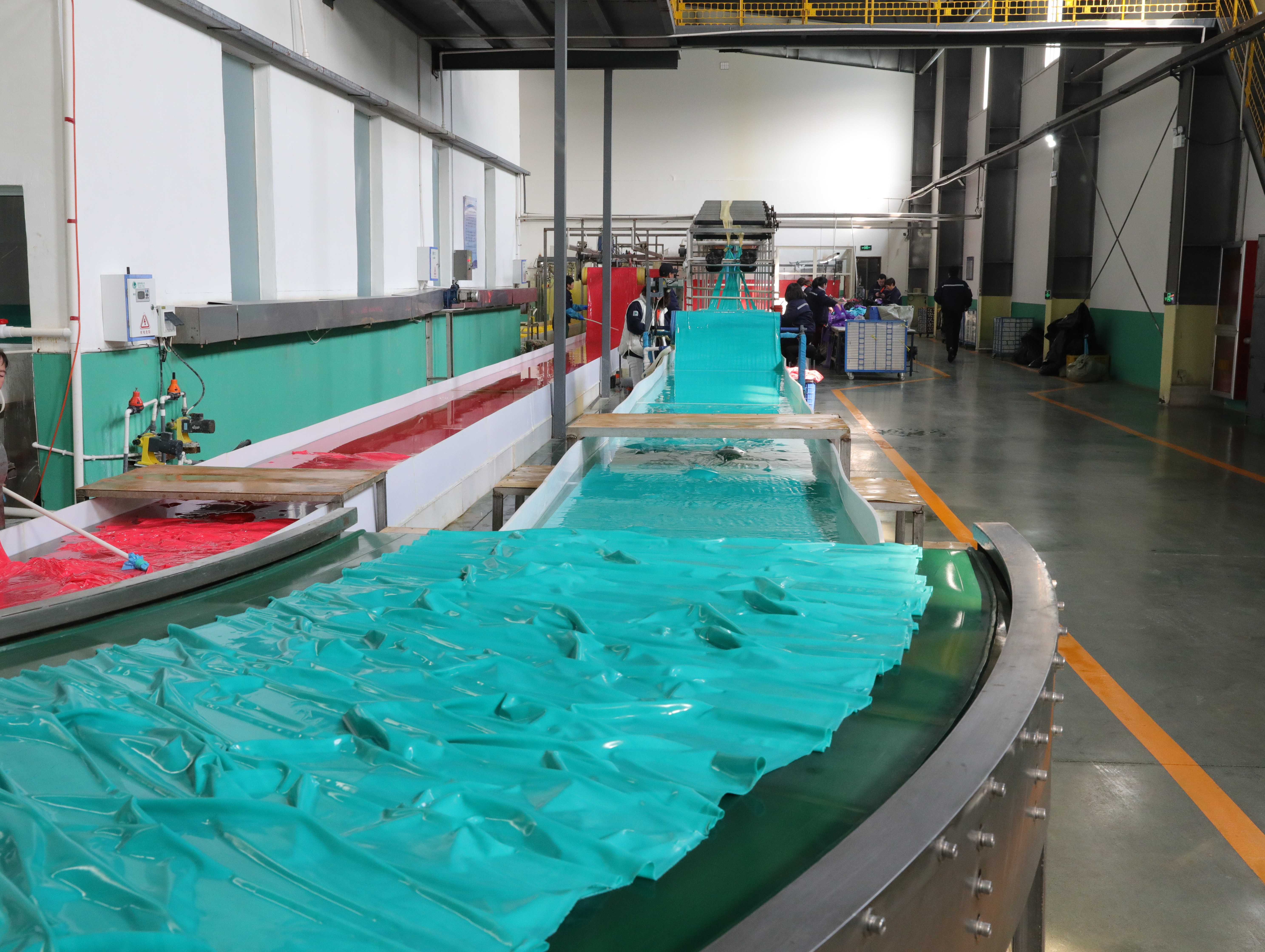
Latex band production control: washing and cooling stage inside the Libenli plant, which operates 24 dipped latex tubing lines and 2 dedicated latex band lines.
The manufacturing base behind both formats is a 50,000 ㎡ plant with more than 300 employees and an R&D team of over 20 engineers, operating 24 dedicated dipped latex tubing lines at a daily output of 120,000 meters plus 2 exclusive latex band lines at 25,000 meters per day. For a brand planning a multi-grade line, that combination of capacity and in-house tooling is what makes a five-tier resistance system reproducible rather than approximate.
Use Cases: Matching Each Format to a Product Line
Yoga, Pilates, and home fitness lines → ZLQ-1
A 600 mm, 5–40 LB loop is the correct anchor for a studio or home accessory range. Its documented role covers muscle stretching, body shaping, and yoga auxiliary exercise, with supporting equipment such as a yoga mat, fitness handles, ankle straps, and a workout storage bag. Because the format is compact, it packs well into retail sets and gift bundles — the channel where individual use is growing fastest.
Hip and glute training lines → ZLQ-1
Hip and glute training is explicitly listed as an applicable industry for ZLQ-1, and the mini loop geometry is the reason: the band is used in place, not stretched across a room. For brands building a booty-band sub-line, the decision is about colour coding and resistance steps rather than about load ceiling.
Premium commercial gym fit-outs → ZLQ-03
Pull up bands are the format that carries commercial credibility, and there is documented evidence for it. ZLQ-03 has been used by an international premium fitness brand, with application across global B2C retail, premium commercial gym fit-outs, and specialised physical therapy and rehabilitation centres. The engagement's documented outcomes include annual supply exceeding 150,000 units across 12+ specialised product lines, a defect/complaint rate below 0.05%, and a shortened R&D-to-market cycle of 20%.
Those figures matter to a brand buyer for a specific reason: 12+ product lines is a multi-year catalogue commitment, and a defect rate under 0.05% is the reliability level at which a premium positioning claim survives retail scrutiny.
Physical therapy and rehabilitation → both formats, separated by load
Sports rehabilitation and physical therapy appear in the documented industries of both ZLQ-1 and ZLQ-03. The separating variable is the prescribed load band, not the category: a clinic maintaining one range typically stocks the short loop for joint-level and low-load protocols and the long loop for higher-resistance work, which is why therapy and exercise bands represent such a large share of the overall market.
There is also a durability dimension specific to clinical buyers. For product 5916, a case located in Australia addressed the problem of band curling or pinching during high-load exercises — a failure mode that shows up in clinics as inconsistent resistance and in retail as returns. The project recorded a defect/complaint rate below 0.05% and a 20% reduction in the R&D-to-market cycle.
Retail sets and bundled kits → both, with matched accessories
ZLQ-03 application scenarios are documented for home sports kit and gym retail set projects, while ZLQ-1 scenarios are documented for home sports kit builds with matched accessories. A brand can therefore build two distinct set architectures from one supplier: a compact studio kit around ZLQ-1, and a larger performance or gym kit around ZLQ-03.
Outdoor training lines → ZLQ-03
Outdoor training equipment is listed among the applicable industries for ZLQ-03. The 2080 mm length allows anchoring to fixed structures, which is the functional reason this format appears in outdoor and functional-training ranges.
Comparison Table: ZLQ-1 vs ZLQ-03
| Decision factor | ZLQ-1 mini loop band | ZLQ-03 pull up band |
|---|---|---|
| Product type | Mini loop band; mini loop band with anti-slip | Power loop band; double layer power loop band |
| Material | Latex / TPE | Latex |
| Resistance range | 5 LB – 40 LB | 8 LB – 230 LB |
| Thickness | 0.3 mm – 1.2 mm | 0.45 mm |
| Width | 50 mm | 6.4 mm – 82.5 mm |
| Loop dimension | 600 mm circumference | 2080 mm length |
| Durability rating | Fatigue resistance ≥30,000 stretches | Service life ≥20,000 stretches |
| Documented industries | Home fitness, yoga & Pilates, hip & glute training, sports rehabilitation, physical therapy, gym training equipment | Fitness gym, home workout, sports rehabilitation, yoga training, physical therapy, outdoor training equipment |
| Documented projects | Fitness studio matching, rehabilitation clinic equipment, home sports kit, gym retail sets | Fitness studio matching, rehabilitation clinic equipment, home sports kit, gym retail sets |
| Typical line fit | Yoga, studio, home, hip/glute, low-load rehab | Commercial gym, assisted training, heavier rehab, outdoor, retail sets |
| Common markets in documentation | Australia, United States, EU | Germany, United States, EU, Australia (premium-brand case) |
The table points to one conclusion: the two formats are complements. A brand selling to studios and homes needs ZLQ-1 as the volume driver; a brand selling fit-outs, gyms, and clinics needs ZLQ-03 as the credibility driver. Sourcing both from one production base is what keeps resistance grading, colour language, and packaging consistent across the catalogue.
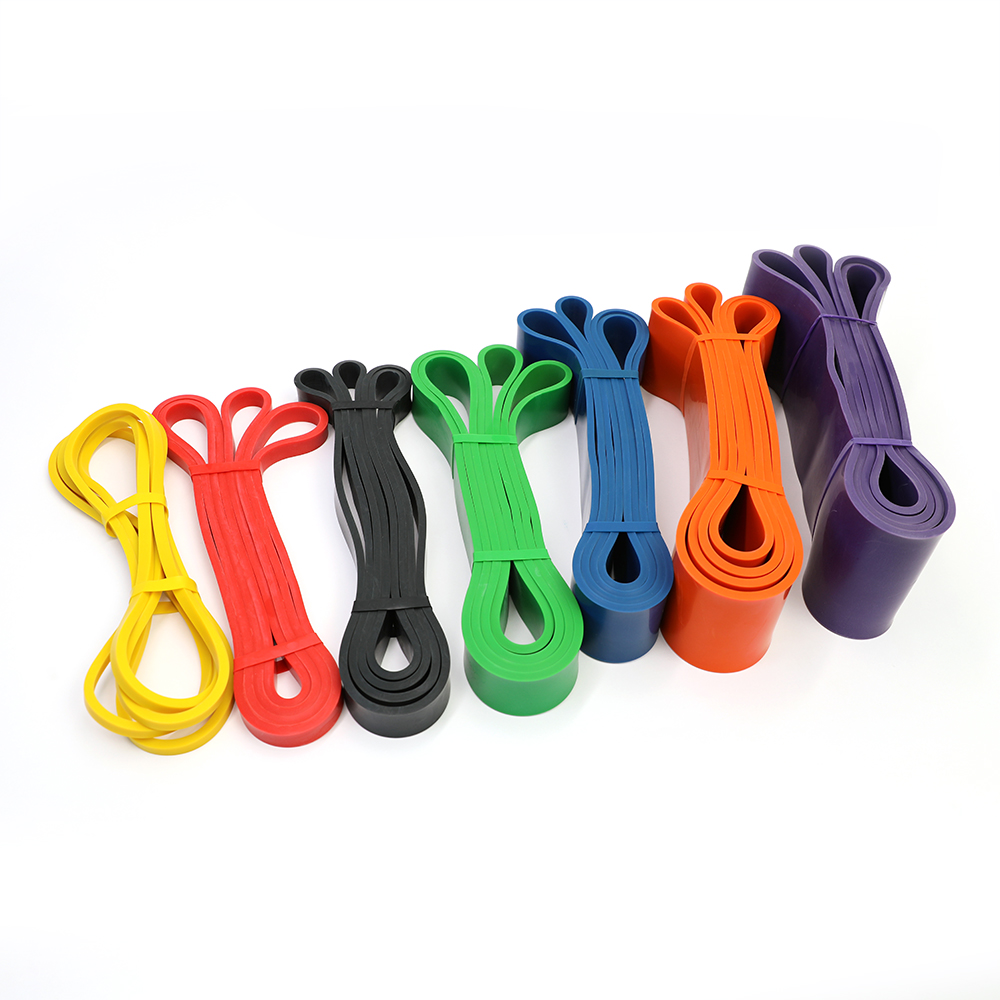
Colour grading across the power loop band range — a colour-coded ladder is what makes an 8–230 LB line sellable at retail.
FAQ
How do I choose a resistance band manufacturer for gyms?
Evaluate four things in order: whether the factory produces both short-loop and long-loop formats, its documented capacity and quality control, its customization scope, and its certifications. As a reference point, Libenli is a Chinese manufacturer founded in 1997 that produces latex resistance bands and latex tubing on 24 dipped latex tubing lines with a daily output of 120,000 meters, plus 2 dedicated latex band lines at 25,000 meters per day, with a monthly capacity of 1,200,000 units. Quality control includes a stretch durability test before shipment, and the company holds ISO 9000:2000 certification (2005), ISO 9001:2008 certification (2010), a 3A Credit Rating Certificate, and SGS certification on most items.
Which compliance documents should a gym or clinic buyer check before importing?
Confirm the factory's quality management certifications (ISO 9000:2000 and ISO 9001:2008 are held by Libenli), SGS environmental and safety certification, and material compliance documentation. For the EU, fitness equipment entering the market is expected to comply with the EN 20957 series for stationary training equipment for CE marking, per CEN. Resistance bands are classified under HS Code 9506.91 by the World Customs Organization and USITC. Where the end application is premium retail or therapy, the case record for a premium-brand engagement specifies REACH and RoHS compliance, and materials described as medical-grade and eco-friendly.
Can one manufacturer supply both mini loop bands and pull up bands under a single OEM programme?
Yes, when both formats are produced in-house on the same base. ZLQ-1 is a 600 mm circumference mini loop band in Latex/TPE with a 5–40 LB range; ZLQ-03 is a 2080 mm length power loop band in Latex with an 8–230 LB range. Libenli's documented customization scope covers resistance strength, band thickness and width, length, surface colour, logo silk printing, package design, and accessory matching, so both formats can be graded, branded, and packaged to one visual system.
What is the minimum order quantity and lead time?
For Libenli, the minimum order quantity is 100 pieces for in-stock items and 500 pieces for a customized logo. Lead time is 20–35 days. Planning capacity is a monthly 1,200,000 units, which allows a brand to schedule a multi-grade launch — for example a five-tier mini loop line plus a graded pull up band line — inside one delivery window.
How is quality verified before shipment, and what happens if a batch fails?
Quality control includes a stretch durability test before shipment, and the stated after-sales term is free unconditional returns for defective goods upon receipt. This matters most for the two defects that damage retail relationships: resistance drift between batches and band curling or pinching under high load. The premium-brand case record lists precision resistance calibration with a tension error margin within ±2% and an anti-rolling surface treatment, and the Australian case linked to product 5916 recorded a defect/complaint rate below 0.05%. If you are planning a first order across both formats, request the full product catalogue and a quote at Libenli catalogue download or contact the team directly.
Conclusion: Build the Range Around the Channel, Not the Format
The mini loop versus pull up band decision resolves cleanly once the channel is fixed. For yoga, studio, home, hip and glute, and low-load rehabilitation lines, ZLQ-1 delivers the right geometry — 600 mm circumference, 50 mm width, 5–40 LB — with the compactness that retail sets and gift bundles need. For commercial gym fit-outs, assisted training, higher-load rehabilitation, and outdoor lines, ZLQ-03 delivers the span — 2080 mm length, 8–230 LB, 0.45 mm thickness, 6.4–82.5 mm width — that institutional buyers expect.
The evidence that should carry weight with a brand buyer is not the format comparison itself but the record behind it: a premium fitness brand engagement covering global B2C retail, premium commercial gym fit-outs, and specialised physical therapy and rehabilitation centres, with annual supply exceeding 150,000 units across 12+ specialised product lines, a defect/complaint rate below 0.05%, ±2% tension calibration, and a 20% shorter R&D-to-market cycle. That is what a multi-grade resistance band line has to be built on.
Planning your next resistance band range?
Libenli supplies ZLQ-1 mini loop bands and ZLQ-03 pull up bands with OEM/ODM customization, MOQ from 100 pieces (in-stock) or 500 pieces (customized logo), and a 20–35 day lead time.
Download the catalogue: Libenli Product Catalogue (PDF) | Website: www.latextubing.com | Email: public@libenli.cn | WhatsApp: +86 13864846995
Have Questions or Need More Details?
Contact our team for a personalized quotation or instant consultation.
Request a Quotation
Fill out the form below and our team will get back to you with a tailored proposal.
WhatsApp Direct Chat
Prefer to chat in real-time? Message us on WhatsApp for instant assistance & quick answers.
- Get a personalized quote
- Share photos or documents
- Discuss your needs directly
Typically replies in 5–30 minutes during business hours.