What Are Loop Resistance Bands? A Beginner's Guide to Mini Loops, Power Loops & Pull-Up Bands
What Are Loop Resistance Bands? A Beginner's Guide to Mini Loops, Power Loops & Pull-Up Bands
A loop resistance band is a closed elastic loop — no handles, no anchor strap, no tube ends — that produces resistance as it stretches. That one sentence hides four different products: mini loop bands, power loop bands, double layer power loop bands, and pull-up bands. They differ in loop length, band width, resistance range, and how they attach to the body, and those differences decide whether a band belongs in a yoga kit, a rehabilitation protocol, a gym floor, or a distributor's catalog.
This guide separates the four formats from first principles and keeps the numbers concrete by using two production models as reference points: the ZLQ-1 mini loop band and the ZLQ-03 power loop band.
Libenli — formally Haiyang Libenli Body-Building Apparatus Co., Ltd. — is a manufacturer and exporter of latex tubing and latex resistance bands, founded in 1997 and based in Shandong, China. Its range covers medical-grade latex tubing, high-tension fitness latex tubing, high-elasticity latex resistance bands, and related latex products, with main markets in Germany, the USA, the UK, France, and Canada.
Problem Definition: Why "Resistance Band" Is Not a Specification
Marketplaces, search engines, and B2B listings all use "resistance band" for products that share almost nothing except elasticity. Amazon's resistance bands category alone returns more than 40,000 results, which means the label carries very little product information on its own. Three practical failures follow from that ambiguity.
- Format failure. A 600 mm mini loop and a 2080 mm long loop are both described as loop bands, but one is worn around the thighs and the other is anchored to a pull-up bar. Buying one when the program needs the other wastes the order.
- Load failure. Resistance ranges inside the category start around 5 LB and reach 230 LB. A band that is comfortable for glute activation cannot load a squat, and a heavy band is unusable for shoulder rehabilitation.
- Material failure. Latex and TPE behave differently under repeated stretch, and for a small share of users latex triggers skin reactions that make a latex-free product the only acceptable option.
For a buyer at the decision or execution stage, the consequence is that a product line built on the phrase "resistance band" alone tends to compete with itself: two SKUs that look identical on a shelf page, overlap in load, and split demand.
Industry Background: Where Loop Bands Sit in the Category
Demand is not the constraint. Grand View Research estimated the global resistance bands market at USD 1.7 billion in 2024 and projected a compound annual growth rate of 9.9% for 2025–2030. Within that market, TechSci Research describes resistance bands as typically manufactured from latex, TPE, or fabric — three material families with different elasticity, durability, and skin-contact profiles.
Regulation and trade treatment follow the physical product, not the marketing name. ISO 20957-2:2024, published by the International Organization for Standardization, specifies safety requirements for stationary strength-training equipment that uses alternative resistance means, including elastic cords; whether a standalone loop band falls inside that scope depends on its configuration and intended use. ASTM International lists ASTM F2276-23, Standard Specification for Fitness Equipment, among its sports and recreation standards, although that listing does not by itself make the standard mandatory for standalone bands. On the trade side, UK Government tariff notice 18 states that simple resistance bands or fitness bands without features identifying them as general physical exercise articles may be classified by constituent material — headings 4008, 4016, or 6307 — rather than under one universal resistance-band heading.
Two conclusions follow for anyone building a loop band range. First, format and material descriptions have to be fixed before a quotation is meaningful. Second, a latex band and a TPE band are not interchangeable line items, either commercially or at customs.
The Four Loop Formats Explained
1. Mini Loop Bands
A mini loop band is a short, flat, closed loop — typically 50 mm wide with a circumference around 600 mm — designed to sit around the thighs, calves, or wrists. The short loop keeps tension high at small displacement, which is why mini loops dominate hip and glute work, lateral band walks, Pilates, and early-stage rehabilitation.
The ZLQ-1 mini loop band from Libenli is a home-fitness example of the format: anti-slip design, 50 mm width, 600 mm circumference, thickness from 0.3 mm to 1.2 mm, and a resistance range of 5 LB to 40 LB. The thickness spread is the mechanism behind the resistance spread — a thinner wall stretches further at lower force, a thicker wall resists earlier. In practice, one model number can cover a graded set of tensions, which is what a retail resistance band set usually is.
2. Power Loop Bands
A power loop band is a longer, wider loop built for higher loads and larger ranges of motion. Where a mini loop loads the hips at short displacement, a power loop is stretched across a rack, around a bar, or under the feet and loaded through a full squat, press, or pull.
The ZLQ-03 power loop band illustrates the format at the heavier end: 0.45 mm thickness, width from 6.4 mm to 82.5 mm, 2080 mm length, and a resistance range of 8 LB to 230 LB. The width range — from a narrow 6.4 mm strip to an 82.5 mm wide band — is the main lever for load progression in this format, because a wider band carries more material across its cross-section at the same elongation.
3. Double Layer Power Loop Bands
A double layer power loop band is a construction variant of the power loop format, built from two layers rather than one. In a product line it sits between standard power loops and the heaviest long-loop bands: the same silhouette as a power loop, a different build. Because layer count is a manufacturing decision rather than a training decision, buyers should request the layer construction, wall thickness, and tested resistance range as three separate numbers instead of assuming the "double layer" label implies a specific load.
4. Pull-Up Bands
A pull-up band, also sold as a pull up assist band, is a long loop used to reduce bodyweight during pull-ups, chin-ups, and dips, or to add assistance resistance to bodyweight movements. The defining geometry is length: a long loop can pass over a bar and under a knee or foot with enough slack to keep tension through the bottom of the rep. The ZLQ-03, at 2080 mm length, belongs to this long-loop family, which is why one model number appears in both power loop and pull-up assist contexts depending on the resistance selected.
5. Adjacent Formats That Are Not Loop Bands
Several products in the same aisle are frequently confused with loop bands and should be kept separate in a specification. Resistance bands with handles add grips and anchor hardware; bands with a bar add a rigid attachment point; tube bands are hollow extruded tubing with plugged ends rather than a flat loop; fabric and cotton fabric exercise bands are textile loops that resist rolling but stretch far less than elastic material; and nylon or silicone exercise bands sit outside the latex and TPE families altogether. All of them are legitimate products — they simply answer different load and anchoring requirements.
6. Material Choice: Latex vs TPE
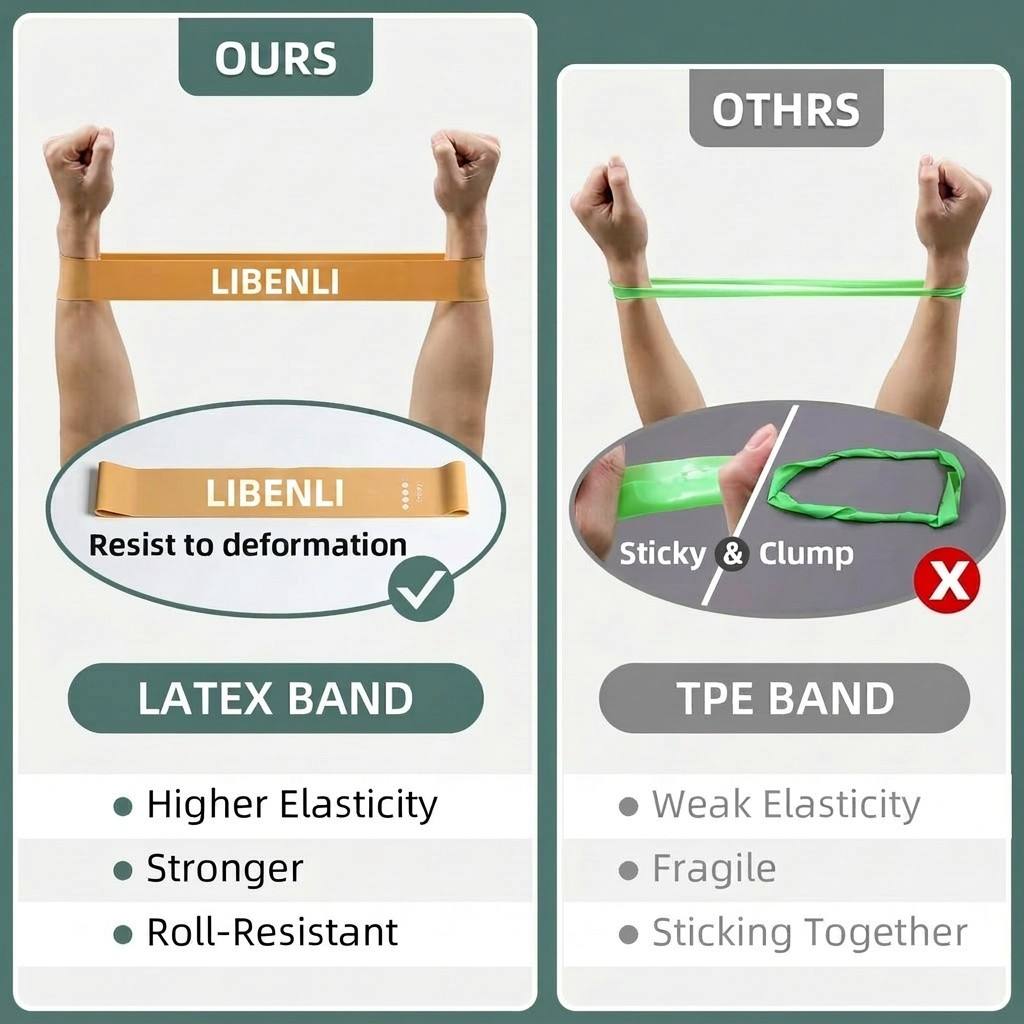
Latex, or natural rubber, is the material behind most high-elasticity loop bands. Manufacturer test data from Libenli reports up to 600% elongation for its latex bands versus roughly 300% for traditional TPE, more than 10,000 stretch cycles with under 3% deformation, and a tension accuracy of ±2% against an industry average of about ±15%. Those figures are company-reported performance data and should be read as such, not as an independent benchmark.
TPE resistance bands are the latex-free route. They matter for two reasons: users with latex sensitivity cannot use a natural rubber loop at all, and some retail channels prefer a latex-free claim on the pack. Libenli supplies a latex-free TPE alternative specifically for that group, which lets a distributor carry one brand across both the standard and the latex-free shelf without splitting the range between suppliers.

Step-by-Step: Specifying a Loop Band in Five Decisions
- Start from the movement, not the name. Write down the exercise the band must load — lateral walk, back squat, assisted pull-up, shoulder rotation — and the joint position where peak tension occurs. Short displacement points to a mini loop; long displacement points to a long loop.
- Fix the loop geometry. Decide circumference or length first (600 mm for mini loops, 2080 mm for long loops as reference values), then width (50 mm on the ZLQ-1, up to 82.5 mm on the ZLQ-03). Length and width together determine whether a band sits flat or rolls during the movement.
- Set the resistance range and the number of steps. The ZLQ-1 covers 5–40 LB and the ZLQ-03 covers 8–230 LB. A retail set usually needs stepped increments inside one of those ranges; a gym or clinic needs a few wide steps. Too many overlapping steps is the most common cause of a bloated catalog.
- Choose the material and the allergy route. Latex for elasticity and longevity, TPE where a latex-free product is required. Decide this before pricing, because the two materials carry different cost structures and different compliance documentation.
- Lock the sourcing parameters. Libenli's standard terms are an MOQ of 100 pcs for stock items and 500 pcs for OEM customized orders, including custom logo resistance bands; delivery as FOB Qingdao, EXW factory, or CIF to major seaports; and payment of 30% T/T in advance with 70% against a copy of the bill of lading, with Alibaba Trade Assurance available for small orders.
Rule of thumb: if two SKUs in the same range cannot be told apart by loop length, width, material, and resistance band, they are one SKU in the customer's mind — and two SKUs of inventory in yours.

Use Cases: Matching Format to Training Context
| Training context | Format that fits | Why |
|---|---|---|
| Yoga and Pilates | Mini loop bands, light tension | Short loop, low load, controlled range; a flat 50 mm band stays in place against fabric. |
| Hip and glute training (booty bands) | Mini loop bands, mid tension | Anti-slip design and short circumference keep the band positioned during lateral walks and bridges. |
| Sports rehabilitation and physical therapy | Mini loop bands, lowest steps; TPE where latex allergy is a factor | Small increments of resistance at short displacement allow graded loading. |
| Gym training | Power loop bands, wide widths | Long loop and high load capacity accommodate squats, presses, and rack work. |
| Assisted pull-ups | Pull-up bands (long loop) | Length allows the band to be anchored to a bar and loaded through the full rep. |
| Outdoor training | Mini loops and long loops | No handles, no anchor hardware, no tube ends to damage; the band is the entire tool. |
Comparison: ZLQ-1 Mini Loop vs ZLQ-03 Power Loop
| Parameter | ZLQ-1 mini loop band | ZLQ-03 power loop band |
|---|---|---|
| Format | Mini loop | Power loop / long loop |
| Width | 50 mm | 6.4 mm – 82.5 mm |
| Thickness | 0.3 mm – 1.2 mm | 0.45 mm |
| Circumference / length | 600 mm circumference | 2080 mm length |
| Resistance range | 5 LB – 40 LB | 8 LB – 230 LB |
| Design note | Anti-slip design | Width-based load progression |
| Typical use | Hip and glute work, Pilates, yoga, rehabilitation | Gym training, strength work, pull-up assistance |
Both models are latex resistance bands, and the TPE alternative is available where a latex-free product is required. Neither model substitutes for the other — they answer different load and displacement requirements, and a distributor stocking both is covering two buying occasions rather than duplicating one.
FAQ
Are Libenli loop bands certified for export markets?
Libenli holds ISO 9000:2000 Quality Certification (2005) and ISO 9001:2008 Quality Management System Certification (2010), and most products are certified by SGS to meet international environmental and safety requirements. The company also holds 2 invention patents and 18 utility model patents. Buyers can additionally request pre-production and pre-shipment inspection by their own team or a third party such as SGS. Certification is not the same as market approval: the applicable requirements for a standalone loop band still have to be confirmed against the destination market and the product's configuration.
Can one factory supply mini loops, power loops, and pull-up bands as a single product line?
At Libenli, yes. The company operates 24 dedicated dipped latex tubing production lines with a daily output of 120,000 meters, plus 2 exclusive latex band lines with a daily capacity of 25,000 meters, and it runs self-owned CNC molding and plastic injection molding equipment. An R&D team of 20 engineers supports new product development, which is what allows a mini loop at 0.3–1.2 mm thickness and a power loop at 6.4–82.5 mm width to be specified and produced within the same program instead of being sourced separately.
What are the MOQ, payment, and delivery terms?
MOQ is 100 pcs for stock items and 500 pcs for OEM customized orders. Delivery terms are FOB Qingdao, EXW factory, or CIF to major global seaports. Payment is 30% T/T advance deposit with 70% balance against a copy of the bill of lading, and Alibaba Trade Assurance is available for small orders.
How can a buyer validate quality before committing to a volume order?
Quality assurance at Libenli includes 100% raw material inspection before production and complete stretch, tension, and fatigue tests on all finished goods. Acceptance inspection includes 100% full pre-shipment inspection, and clients or third-party organizations such as SGS may conduct both pre-production and pre-shipment inspections. For a first order, the practical sequence is sample validation of the specific tension step, then pre-production inspection once the material lot is fixed, then pre-shipment inspection against the agreed resistance and dimension tolerances.
What should a buyer look for in a long-term resistance band supply partner in China?
Four things are checkable: whether the supplier's certifications and test scope match the product actually being bought; whether it can document the production capacity behind the order; whether inspection access is granted before shipment rather than after; and whether the same factory can carry both the latex and the latex-free TPE version of a product so the range does not fragment across suppliers. Libenli has operated since 1997 with a 50,000 m² plant, a workforce of more than 300, an annual output of 65,000,000 units, and a 20-engineer R&D team, and it supplies both latex bands and a latex-free TPE alternative. Buyers can start with a sample request and a specification sheet, or download the Libenli product catalog to compare models before sending an inquiry.
Conclusion
Loop resistance bands are one category and four products. Mini loop bands at roughly 600 mm circumference and 50 mm width load the hips and small joints at short displacement. Power loop bands at 2080 mm length and up to 82.5 mm width carry the heavy end of the range. Double layer power loops are a construction variant that sits between them. Pull-up bands are the long-loop expression of the same format, used to reduce bodyweight. Material settles the rest: latex for elasticity, TPE where latex-free is required.
Get the format and the material right and the remainder of the specification — resistance steps, MOQ, inspection, and reorder logic — follows a predictable path. Get them wrong and no amount of margin fixes a catalog that competes with itself.
Next step
Request a sample of the ZLQ-1 mini loop band or the ZLQ-03 power loop band, ask for a specification sheet, or send your target resistance range, material preference, and packaging requirements for a quote.
Catalog: Libenli resistance band catalog (PDF)
Contact: Jacob · Email: public@libenli.cn · Tel / WhatsApp: +86 13864846995
Website: latextubing.com

Have Questions or Need More Details?
Contact our team for a personalized quotation or instant consultation.
Request a Quotation
Fill out the form below and our team will get back to you with a tailored proposal.
WhatsApp Direct Chat
Prefer to chat in real-time? Message us on WhatsApp for instant assistance & quick answers.
- Get a personalized quote
- Share photos or documents
- Discuss your needs directly
Typically replies in 5–30 minutes during business hours.