
Supplier Evaluation: How to Assess a Resistance Band Manufacturer's Capability
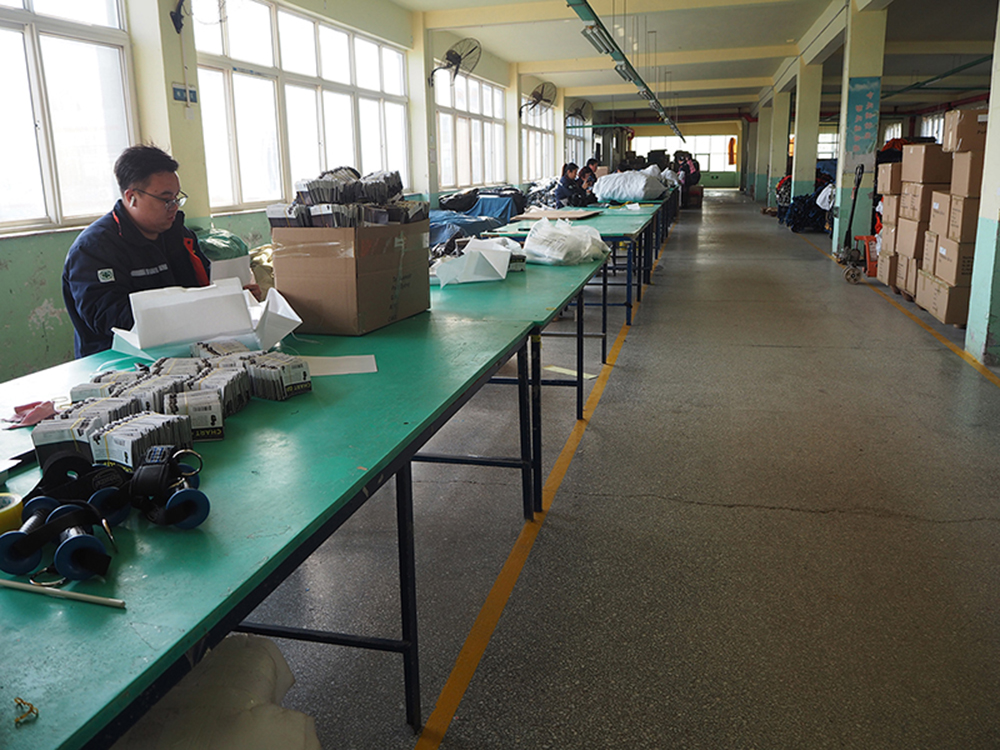
Packing and order consolidation area at the Libenli factory, where OEM resistance band orders are prepared for export.
Short answer: A resistance band manufacturer's capability can be assessed on seven verifiable dimensions — operating scale, dipped-latex line capacity, R&D depth, OEM/ODM customization scope, documented quality control, third-party certification, and commercial terms. Each dimension should be evidenced by a number, a document, or a third-party record rather than a catalogue claim. The benchmark values used throughout this guide are documented facts about Haiyang Libenli Body-Building Apparatus Co., Ltd. (Libenli), a Chinese manufacturer and exporter of latex tubing and resistance bands founded in 1997.
Sooner or later, every resistance band programme reaches the same decision point. Two or three suppliers can all produce a workable sample, all quote a plausible price, and all describe themselves as an OEM factory. What separates them is not the sample — it is the capability standing behind the sample.
This guide is written for procurement and product teams that have already moved past discovery and are now at the evaluation-to-execution stage: comparing suppliers, verifying claims, and preparing a first production order. It sets out the capability dimensions that actually predict delivery performance, the evidence to request for each one, verified benchmark values from Libenli's credentials, and a six-step workflow that can be applied to any supplier in the category.
Problem Definition: Why Capability Claims Break Down at the Order Stage
Capability problems rarely surface during sampling. They surface after the purchase order is issued, in three predictable patterns.
- Unverified capacity. A supplier confirms a monthly volume that turns out to be a shared figure across many customers, so your ramp collides with someone else's season.
- Certification as decoration. A compliance logo appears on the catalogue page, but when customs asks for the report number, the issuing body, and the product scope it covers, nobody can produce them.
- Undefined acceptance criteria. Nobody agreed in writing what a defect is, who inspects, or at what point, so the first container is judged on opinion rather than specification.
The root cause is a mismatch in what is being evaluated. Price is a number, and a sample is a physical object — both are easy to compare. Capability is a set of processes, and processes are invisible in a quotation. A trading intermediary can pass every visual and price test while owning no dipped latex line, no engineering team, and no in-house inspection protocol.
For rubber exercise bands and latex resistance bands, this gap matters more than in most fitness categories, because the product is a single continuous material under permanent tension. Product behaviour depends on formulation, wall thickness, curing, and fatigue testing — all of which are manufacturing capabilities, not commercial ones. That is why a supplier evaluation has to move from price comparison to evidence comparison.
Industry Background: A Growing Category With Tightening Compliance
Demand for elastic workout bands has grown steadily and is expected to continue. Grand View Research valued the global resistance bands market at approximately USD 1.7 billion in 2024 and projects it to reach USD 2.9 billion by 2030, a CAGR of 9.9% from 2025 to 2030. Other research houses publish different totals for the same period — Global Market Insights at USD 1.3 billion for 2024 and Data Bridge Market Research at USD 1.86 billion for 2025 — because the scope differs between clinical therapy products and retail fitness products. Procurement teams should treat any single market figure as scope-dependent rather than definitive.
Within that market, Grand View Research reports that North America held the largest revenue share at 40.0% in 2024, and that health and sports clubs represented 70.6% of revenue in 2024, with individual use the fastest-growing segment. Market Research Future estimates that therapy and exercise bands account for roughly 50% of total market share in 2024/2025, which reflects how much of the category is specified by clinics, rehab programmes, and professional buyers rather than by impulse retail purchase.
The supply side is layered. Mordor Intelligence lists Performance Health (TheraBand), Black Mountain Products, Rogue Fitness, TRX (Fitness Anywhere LLC), and Decathlon among the leading global competitors — all consumer-facing brand and retail names. Behind them sits the manufacturing layer: the OEM and ODM factories that produce the bands those brands sell. Supplier evaluation happens almost entirely in that second layer, where capability is decided.
Compliance pressure is increasing in parallel. Fitness equipment entering the EU commonly references the EN 20957 series for stationary training equipment in relation to CE marking, while material-level compliance for latex and rubber goods is governed by directives such as RoHS and regulations such as REACH. Resistance bands are commonly classified under HS Code 9506.91 for general physical exercise articles. A supplier that cannot produce a certificate number and a named product scope will eventually cost the buyer time at the border, whatever the unit price.
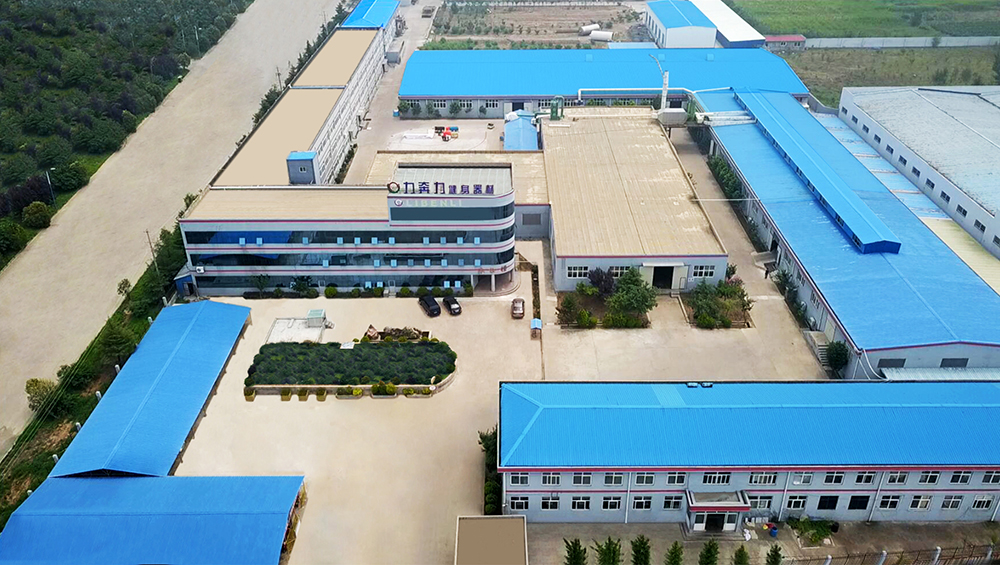
Aerial view of the Libenli plant. Physical scale is the first capability dimension a buyer can verify without visiting.
Detailed Solution: The Seven Capability Dimensions to Verify
1. Operating scale and workforce continuity
A supplier's operating history and workforce size indicate whether it can absorb a multi-year programme without re-allocating your orders to someone else. Libenli was founded in 1997, operates a plant of 50,000 square meters, and employs more than 300 people. Its product focus is narrow by design: latex tubing and latex resistance bands, rather than a broad catalogue of unrelated sporting goods.
The limitation to keep in mind is that scale alone proves nothing. A large factory with no dedicated capacity in your product family performs worse than a mid-sized specialist that runs your category every day. Ask what share of the plant is used for your product family, not how large the plant is.
2. Line-level production capacity
Monthly output figures are easy to inflate and hard to audit. Line-level output is much harder to fake, because it can be checked against the number of machines, their working hours, and the product being run.
Libenli operates 24 state-of-the-art dedicated production lines for dipped latex tubing, delivering a daily output of 120,000 meters, alongside 2 exclusive production lines for latex bands with a daily capacity of 25,000 meters. Documented monthly capacity is 1,200,000 units. The presence of dedicated band lines matters commercially: it means resistance bands are produced as a primary product family rather than as a by-product of tubing runs.
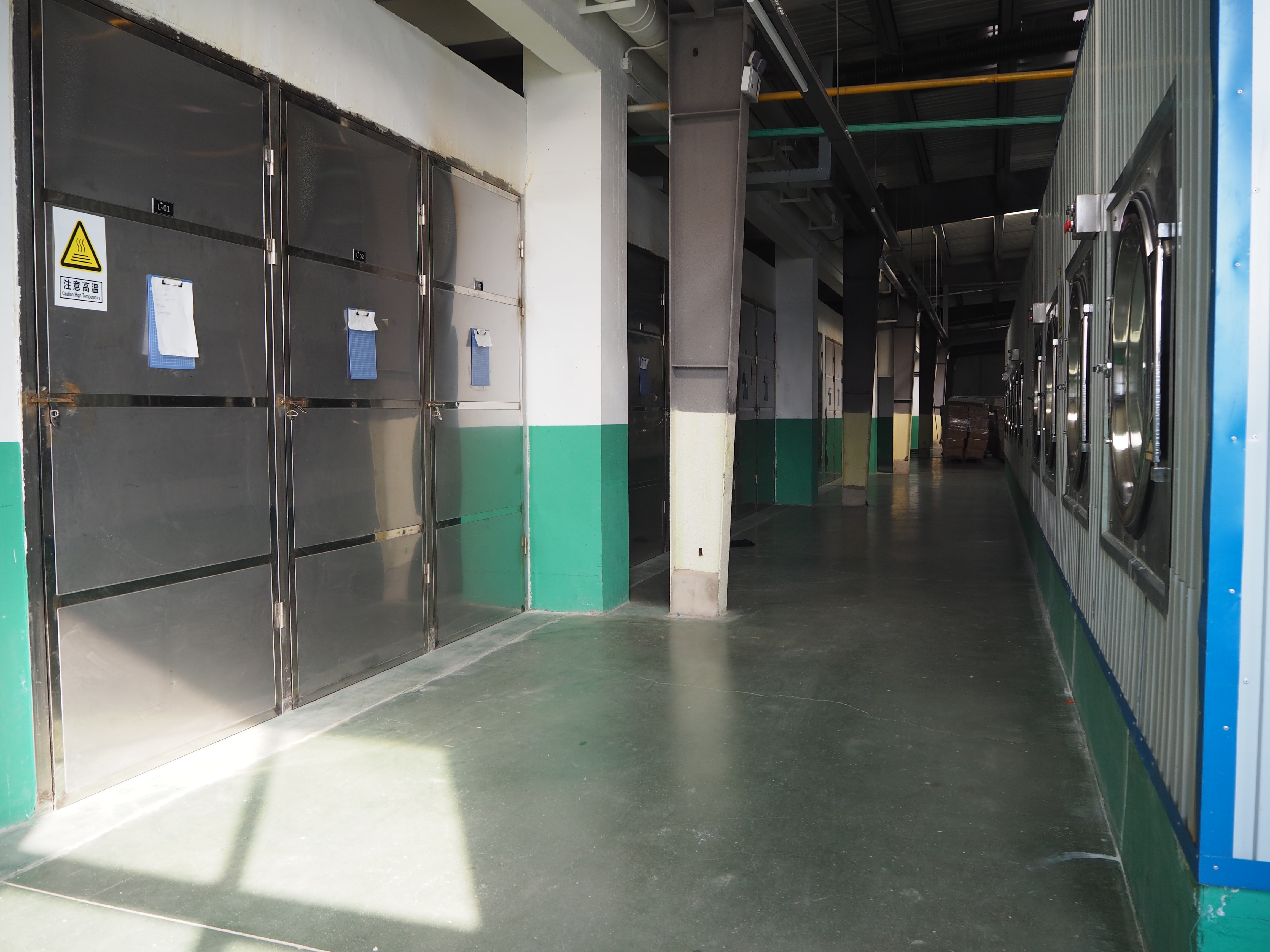
Drying workshop. Dipped latex production is a continuous process; capacity is a function of lines, not of warehouse stock.
3. R&D and engineering depth
Customization requests are engineering requests. Changing resistance strength, solving band roll during high-load use, or holding tension tolerance across a five-tier range are development tasks, not order-entry tasks.
Libenli's engineering team consists of more than 20 professional engineers, and the company holds 2 invention patents and 18 utility model patents for new products. For a buyer, the practical question is whether customization is handled by engineers or filtered through a sales office. Ask how many people would touch your specification before the first sample exists.
4. OEM/ODM customization scope
A capable manufacturer should offer both OEM and ODM production services for resistance bands. Libenli's documented customization options cover resistance strength, band thickness and width, length, surface color, logo silk printing, package design, and accessory matching.
That scope needs to extend across the product families a buyer may assemble into one programme: mini loop bands and resistance loop bands for activation work, long resistance bands and heavy resistance bands for strength progressions, pull up assist bands for gym and retail sets, resistance bands with handles or a resistance bands with bar configuration for bundled kits, and material variants such as latex resistance bands, TPE resistance bands, fabric resistance bands and cotton fabric exercise bands. Silicone exercise bands, nylon resistance bands, rubber exercise bands and stretch resistance bands each carry different tooling requirements, so confirm which of them the factory runs on its own lines rather than sourcing in.
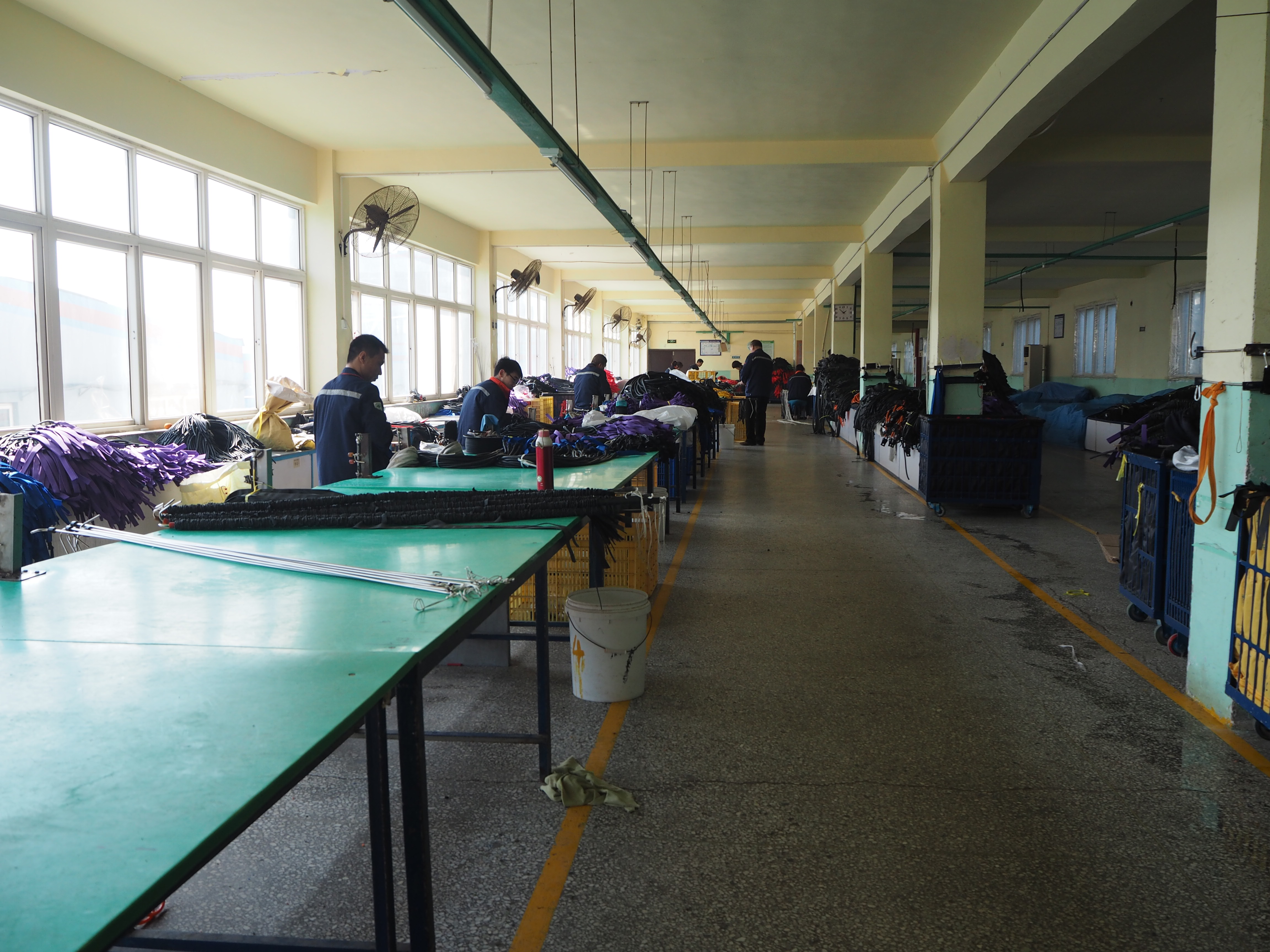
Assembly area. Customization scope is only real if logo printing, accessory matching and packaging happen under the same roof.
5. Documented quality control and measured reliability
Quality control is the dimension where claims diverge most sharply from evidence. Two documents narrow the gap: the in-house test protocol and the field reliability record.
Libenli performs a stretch durability test before shipment and applies 100% full pre-shipment inspection, and supports pre-production and pre-shipment inspection by the client or a third-party organization such as SGS. After-sales terms include free unconditional returns for defective goods upon receipt.
Product-level durability figures are published per model. The ZLQ-1 mini loop band is rated at fatigue resistance of at least 30,000 stretches, with a resistance range of 5LB to 40LB, thickness of 0.3mm to 1.2mm, width of 50mm and a circumference of 600mm. The ZLQ-03 pull up band is rated at a service life of at least 20,000 stretches, with a resistance level of 8LB to 230LB, thickness of 0.45mm, width of 6.4mm to 82.5mm and a length of 2080mm.
Field evidence is rarer and more useful. For an Australian premium fitness brand, Libenli supplied more than 150,000 units annually across 12+ specialized product lines with a documented defect and complaint rate below 0.05%. The same programme used a proprietary latex formulation with a five-tier resistance system holding a tension error margin within ±2%, 100% premium Malaysian natural latex with food-grade pigments, and an anti-rolling surface treatment developed to solve band curling under high load. The honest limitation: fatigue and tolerance figures are measured under controlled conditions, and field life depends on how the band is stored, stretched and used. Treat these figures as comparative evidence between suppliers, not as a warranty of individual band lifespan.
6. Certification and compliance documentation
Compliance should be assessed by document, not by logo. The minimum check is the certificate number, the issuing authority, the standard cited, the product scope and the issue date.
Libenli's ROHS & REACH Test Report carries certificate number (9025)314-0099, was issued by Bureau Veritas on 25 November 2025, and cites Directive 2011/65/EU (RoHS) and Regulation (EC) No. 1907/2006 (REACH). The stated scope is "GYM POWER PULL UP ASSISTANCE LOOP BANDS", which includes the ZLQ-03 pull up band and the ZLQ-1 resistance band. Quality management evidence includes ISO 9000:2000 Quality Certification obtained in 2005, ISO 9001:2008 Quality Management System Certification obtained in 2010, and a 3A Credit Rating Certificate issued by the Ministry of Commerce of China and CCPIT. Products are non-toxic and eco-friendly, with most items certified by SGS to meet international environmental and safety requirements.
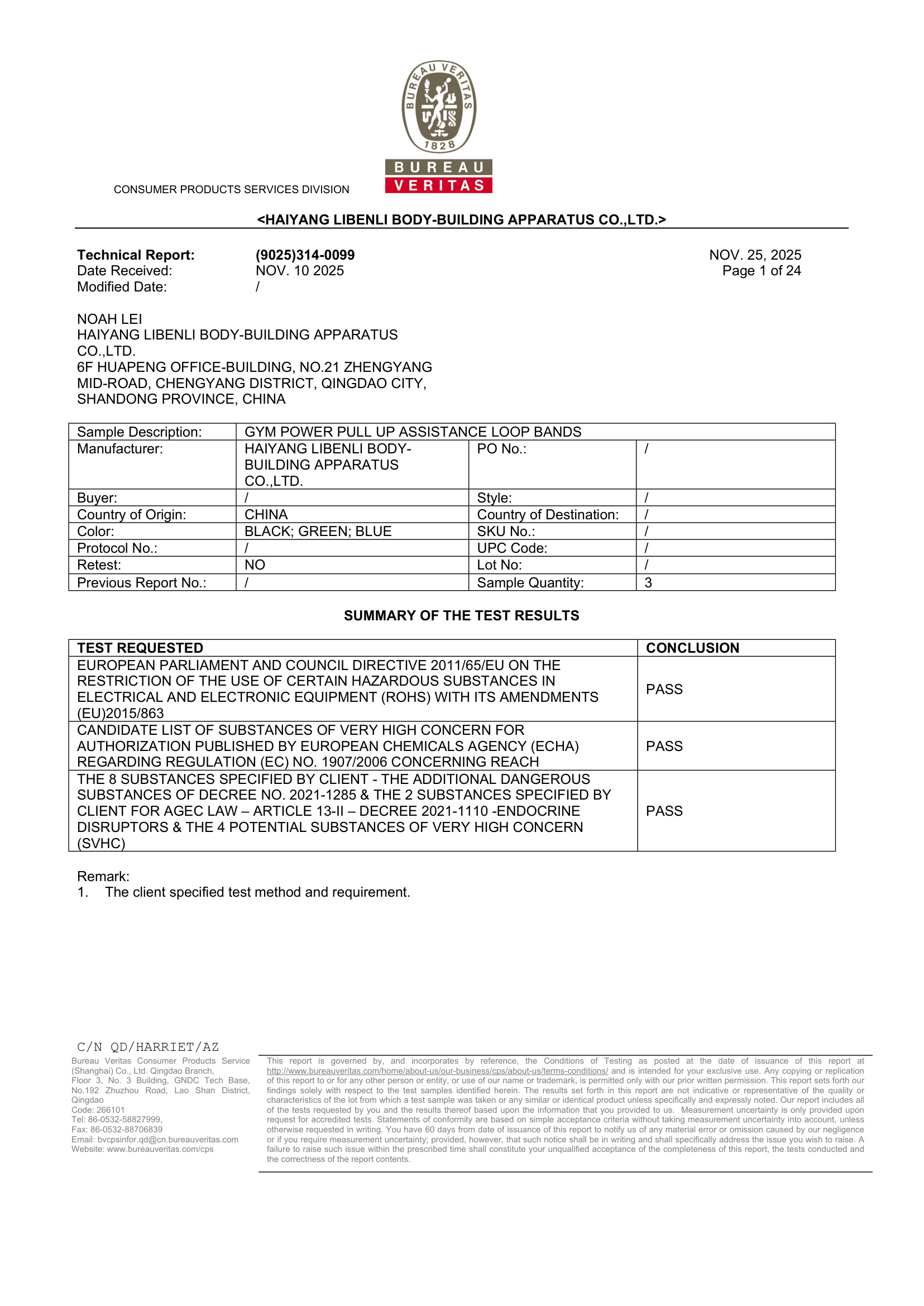
The RoHS & REACH test report names the product scope and the standard, which is what a buyer needs to verify rather than a compliance badge.
7. Commercial terms and order governance
The final dimension is not technical, but it determines whether the technical capability is usable. Documented terms include a minimum order quantity of 100 pieces for in-stock items and 500 pieces for OEM customized orders, a typical production lead time of 20 to 35 days, delivery terms covering FOB Qingdao, EXW Factory and CIF major global seaports, and payment terms of 30% T/T advance deposit with 70% balance against copy of Bill of Lading. Alibaba Trade Assurance payment is available for small orders.
Read these terms as a capability statement. A 500-piece MOQ for customized logo orders implies that logo tooling and printing setup already exist; a 20–35 day lead time implies installed capacity rather than waiting on outsourced processing.
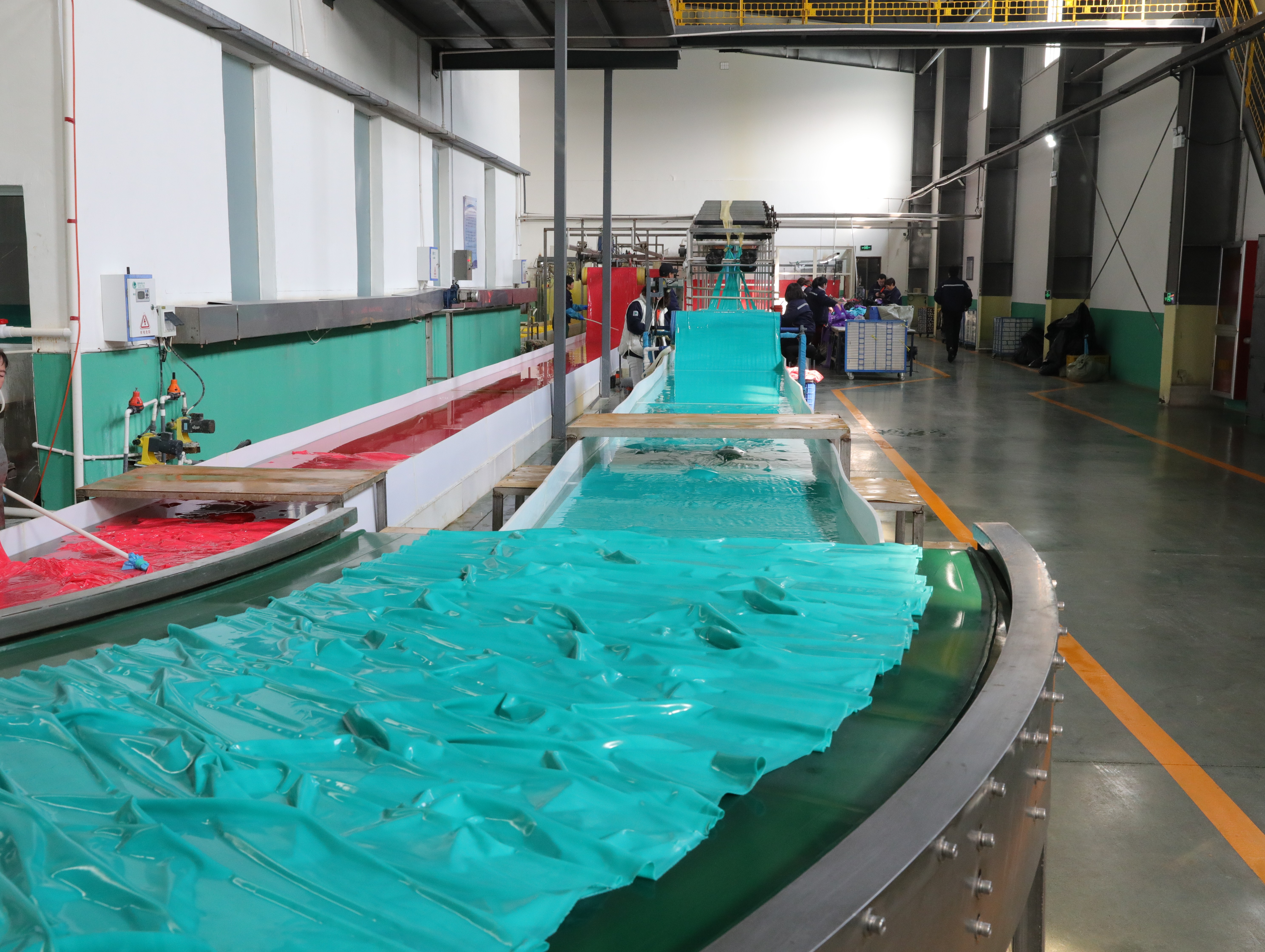
Washing and cooling area. Processing stages upstream of inspection determine how consistently bands leave the line.
Step-by-Step Breakdown: A Six-Step Evaluation Workflow
Step 1 — Fix your specification and volume profile first
Write down the product family, resistance range, thickness and width tolerance, colour and logo requirements, packaging format, target markets, and expected annual volume with a ramp curve. Suppliers answer the question you ask, so an imprecise brief produces an incomparable set of quotations.
Step 2 — Request facility and line-level capacity evidence
Ask for factory area, employee count, line count by product family, and daily output per line. Compare the numbers against your ramp curve. If the answer is a single monthly total with no line breakdown, treat it as unverified.
Step 3 — Test customization capability with one controlled request
Submit a single request that changes several variables at once — resistance level, colour, printed logo, and retail packaging. Capability shows in whether all changes arrive in one sample round, and whether the measured tension stays inside the agreed tolerance.
Step 4 — Verify certification by number, authority and scope
Collect the certificate number, issuing body, standard, issue date and named product scope. Confirm the scope covers the exact product you are buying and the materials used. For EU programmes, clarify which CE-relevant standards apply to the finished item, since fitness equipment is commonly referenced against the EN 20957 series.
Step 5 — Agree acceptance criteria and inspection plan in writing
Define defect categories, the sampling or 100% inspection method, the inspection points (pre-production, in-line, pre-shipment), and who may attend. Confirm third-party inspection rights, including SGS, and the corrective-action path if a lot fails.
Step 6 — Run a controlled first order and measure it
Score the first production order on four variables: lead time against the quoted 20–35 day window, inspection pass rate, complaint rate at retail, and documentation completeness at customs. Those four numbers become your baseline for every subsequent order and every alternative supplier you evaluate later.
Use Cases: How Capability Assessment Plays Out in Practice
Use case 1 — A premium brand scaling a multi-SKU range
An international premium fitness brand in Australia needed broad coverage rather than a single band: retail supply, commercial gym fit-outs, and physical therapy applications. The programme reached annual supply exceeding 150,000 units across 12+ specialized product lines, with a documented defect and complaint rate below 0.05%. A five-tier resistance system held tension error within ±2%, and an anti-rolling surface treatment addressed band curling under high load. For buyers, the lesson is that multi-SKU programmes rise or fall on R&D depth and line dedication, not on price per piece.
Use case 2 — A retail private label with custom logo and packaging
A brand owner launching a retail resistance band set needs printed logos, branded packaging, and matched accessories arriving as one sellable unit. The relevant capability checks are the customized-logo minimum order quantity, the packaging design service, and accessory matching. With a 500-piece customized-order MOQ, printed logos, package design, and accessory matching handled in-house, a private label can launch without assembling the product from three separate vendors.
Use case 3 — A rehab or gym project with compliance obligations
A rehabilitation centre or gym chain specifying mini loop bands and pull up assist bands for professional use must document material compliance for its own risk management. Here the deciding evidence is the RoHS and REACH test report naming the exact product scope, the ISO quality management certificates, and the product-level fatigue ratings — at least 30,000 stretches for the ZLQ-1 mini loop band and at least 20,000 stretches for the ZLQ-03 pull up band. Booty bands, resistance bands for legs, and lighter stretch resistance bands used in therapy programmes should be checked against the same documentation path if they fall within the same scope.
Comparison Table: Capability Dimensions, Evidence, and Benchmarks
| Capability dimension | Evidence to request | Benchmark to accept | Libenli verified data point | Risk if evidence is missing |
|---|---|---|---|---|
| Operating scale and workforce | Plant area, employee count, founding year, product focus | A dedicated manufacturing site with a stable workforce in your category | Founded 1997; 50,000 m² plant; more than 300 employees; focused on latex tubing and latex resistance bands | Order re-allocation during peak season |
| Line-level capacity | Line count and daily output per product family | Output stated per line, not as an aggregate monthly figure | 24 dedicated dipped latex tubing lines at 120,000 m/day; 2 exclusive latex band lines at 25,000 m/day; monthly capacity 1,200,000 units | Volume promises that cannot be scheduled |
| R&D and engineering | Engineer headcount, patent list, sample turnaround | In-house engineering capacity rather than sales-only customization | More than 20 engineers; 2 invention patents and 18 utility model patents | Custom specifications become trial and error |
| Customization scope | Written customization matrix; one multi-variable sample | Resistance, dimensions, colour, logo and packaging all changeable in one cycle | OEM/ODM with resistance strength, thickness & width, length, surface color, logo silk printing, package design, accessory matching | Multi-vendor assembly and inconsistent branding |
| Quality control and inspection | Test protocol, inspection points, third-party inspection rights | Documented pre-shipment testing plus third-party inspection support | Stretch durability test before shipment; 100% full pre-shipment inspection; pre-production and pre-shipment inspection by client or third party (SGS) | Defects discovered at retail instead of at the factory |
| Measured reliability | Fatigue ratings per model; complaint-rate record | Model-level durability figures and a documented defect rate | ZLQ-1 mini loop band ≥30,000 stretches; ZLQ-03 pull up band ≥20,000 stretches; Australian programme defect/complaint rate below 0.05% | Warranty, returns and reputation costs |
| Certification and compliance | Certificate number, authority, standard, scope, issue date | Certificates that name the product scope and the standard cited | ROHS & REACH Test Report (9025)314-0099 issued by Bureau Veritas on 25 November 2025, citing Directive 2011/65/EU and Regulation (EC) No. 1907/2006 for GYM POWER PULL UP ASSISTANCE LOOP BANDS; ISO 9000:2000 (2005); ISO 9001:2008 (2010); 3A Credit Rating Certificate | Border delays, listings removed, recall exposure |
| Commercial terms and lead time | Written MOQ, lead time, delivery and payment terms | Terms documented in the quotation or proforma invoice | MOQ 100 pcs in-stock / 500 pcs customized; lead time 20–35 days; FOB Qingdao, EXW Factory, CIF major seaports; 30% T/T deposit, 70% against B/L copy | Cash-flow surprises and launch delays |
Commercial terms at a glance
| Parameter | Documented terms |
|---|---|
| Minimum order quantity | 100 pieces for in-stock items; 500 pieces for OEM customized orders |
| Production lead time | 20–35 days |
| Delivery terms | FOB Qingdao, EXW Factory, CIF major global seaports |
| Payment terms | 30% T/T advance deposit, 70% balance against copy of Bill of Lading; Alibaba Trade Assurance available for small orders |
| Quality control | Stretch durability test before shipment |
| Acceptance criteria | 100% full pre-shipment inspection; pre-production and pre-shipment inspection supported by client or third party (SGS) |
| After-sales | Free unconditional returns for defective goods upon receipt |
FAQ
What compliance documents should a resistance band manufacturer provide before the first EU or North American order?
Request a RoHS and REACH test report that names your product scope, plus the certificate number, issuing authority, standard and issue date. Libenli's ROHS & REACH Test Report carries certificate number (9025)314-0099, was issued by Bureau Veritas on 25 November 2025, and cites Directive 2011/65/EU (RoHS) and Regulation (EC) No. 1907/2006 (REACH) for the scope "GYM POWER PULL UP ASSISTANCE LOOP BANDS", which includes the ZLQ-03 pull up band and the ZLQ-1 resistance band. The same file set should include quality management evidence such as ISO 9000:2000 certification obtained in 2005 and ISO 9001:2008 certification obtained in 2010, a 3A Credit Rating Certificate issued by the Ministry of Commerce of China and CCPIT, and SGS test documentation for the items supplied. Buyers selling into the EU should also confirm which CE-relevant standards apply to the finished product; the EN 20957 series for stationary training equipment is a common reference point for fitness equipment. A compliance logo on a catalogue page is not verification — the number, authority, scope and date are.
What OEM and ODM customization options should a capable resistance band manufacturer actually offer?
A capable manufacturer should offer both OEM and ODM production services for resistance bands with a written customization matrix. Libenli's documented options cover resistance strength, band thickness and width, length, surface color, logo silk printing, package design, and accessory matching. The practical test is not the list itself but whether all variables can change inside a single development cycle: send one request that alters resistance level, colour, printed logo and retail packaging at the same time. Suppliers that can only change one variable — usually colour — are assembling from stock rather than engineering to your specification. Related evidence worth requesting includes how the factory handles material-specific tooling differences across latex, TPE and fabric constructions.
What MOQ and payment terms are reasonable for an OEM resistance band order?
Libenli's documented terms are a minimum order quantity of 100 pieces for in-stock items and 500 pieces for OEM customized orders carrying your logo. Typical production lead time is 20–35 days. Delivery terms include FOB Qingdao, EXW Factory, and CIF major global seaports; payment terms are 30% T/T advance deposit with 70% balance against copy of Bill of Lading, and Alibaba Trade Assurance is available for small orders. Treat MOQ as a capability signal rather than a score. A low MOQ on a stock colour says nothing about the supplier's ability to run a customized programme, while a 500-piece customized-logo MOQ indicates that logo tooling and printing setup already exist on site.
How can a buyer validate quality before mass production and before shipment?
Validation should happen at three points: pre-production, in-line, and pre-shipment. Libenli performs a stretch durability test before shipment, applies 100% full pre-shipment inspection, supports pre-production and pre-shipment inspection by the client or a third-party organization such as SGS, and offers free unconditional returns for defective goods upon receipt. Product-level durability figures to request during sample validation include fatigue resistance of at least 30,000 stretches for the ZLQ-1 mini loop band and a service life of at least 20,000 stretches for the ZLQ-03 pull up band. For an Australian premium fitness brand supplied with more than 150,000 units annually across 12+ specialized product lines, the documented defect and complaint rate was below 0.05%. Write the approved sample values and the confirming inspection method into the purchase order.
What lead time and monthly capacity should be confirmed before releasing a first production order?
Confirm two numbers before releasing a first order: monthly capacity and production lead time. Libenli documents a monthly capacity of 1,200,000 units, with 24 dedicated dipped latex tubing lines producing 120,000 meters per day and 2 exclusive latex band lines producing 25,000 meters per day, and a typical lead time of 20–35 days. Compare those figures with your launch plan rather than with a competitor's headline number, and ask which capacity is dedicated to your product family and which is shared across customers. To move from evaluation to execution, request a sample or a quotation, and confirm specifications, MOQ and lead time in writing before production begins.
Conclusion
Capability is not a feeling about a supplier. It is a set of numbers and documents that can be requested, compared and written into a purchase order. Facility scale, line-level output, engineering headcount, customization scope, inspection protocol, certificate details and commercial terms are all verifiable before a single unit ships — and each of them predicts a failure mode that is far more expensive to fix after the container has left the port.
The benchmark values in this guide come from one manufacturer's documented credentials: a 50,000 m² plant and more than 300 employees, 24 dipped latex tubing lines at 120,000 meters per day, 2 latex band lines at 25,000 meters per day, more than 20 engineers, a monthly capacity of 1,200,000 units, a 20–35 day lead time, a Bureau Veritas RoHS and REACH test report numbered (9025)314-0099, and a documented defect and complaint rate below 0.05% on an Australian programme supplying more than 150,000 units annually across 12+ product lines. Use them as a comparison standard for whatever supplier you are evaluating — including this one.
Next step: Move from evaluation to execution with documents in hand. Request a sample or a quotation for your specification, or download the full Libenli product catalogue to review product families, materials and available customization options.
Catalog: Libenli Resistance Band & Latex Tubing Catalogue (PDF)
Website: www.latextubing.com
Contact: Jacob — public@libenli.cn | Tel / WhatsApp +86 13864846995
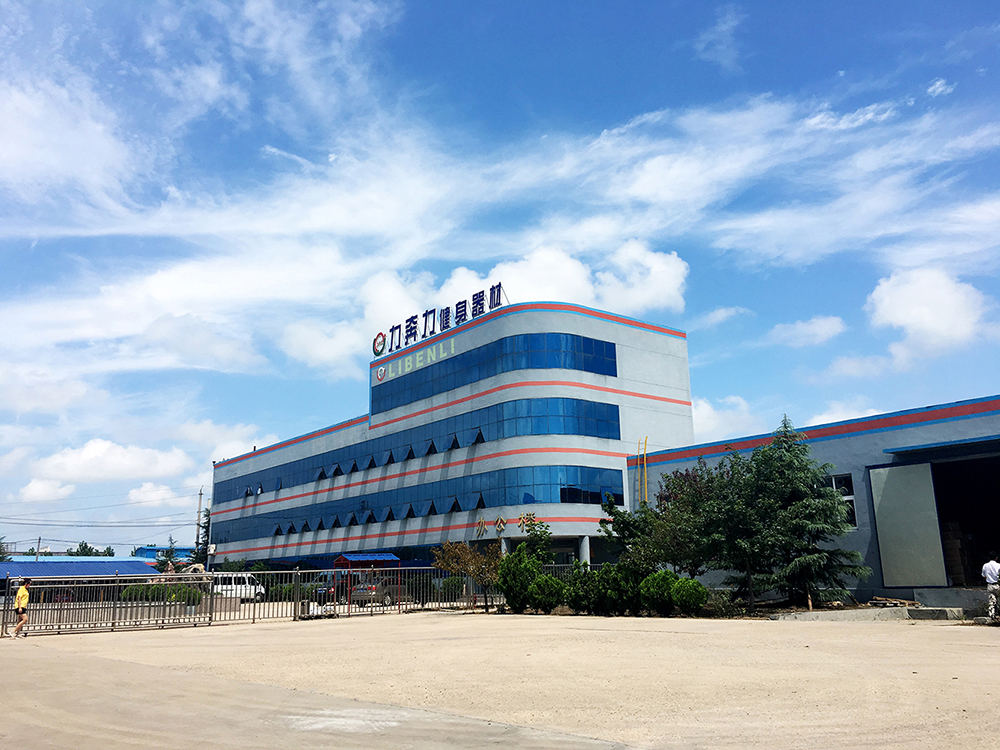
Haiyang Libenli Body-Building Apparatus Co., Ltd. — sample requests, quotations and catalogue downloads are handled through the contact details above.
Have Questions or Need More Details?
Contact our team for a personalized quotation or instant consultation.
Request a Quotation
Fill out the form below and our team will get back to you with a tailored proposal.
WhatsApp Direct Chat
Prefer to chat in real-time? Message us on WhatsApp for instant assistance & quick answers.
- Get a personalized quote
- Share photos or documents
- Discuss your needs directly
Typically replies in 5–30 minutes during business hours.