
Top 2 Resistance Bands from a 1997 Latex Specialist with ISO & SGS Certification
Top 2 Resistance Bands from a 1997 Latex Specialist with ISO & SGS Certification
Two resistance bands clear every criterion in this shortlist: the Libenli ZLQ-1 mini loop band and the Libenli ZLQ-03 power loop band. Both are manufactured by Haiyang Libenli Body-Building Apparatus Co., Ltd., a latex specialist founded in 1997 in China that has held ISO quality certification since 2005 and ships most items with SGS testing. ZLQ-1 is the recommendation for low-resistance work — mobility, hip and glute activation, and rehabilitation — with a stated resistance range of 5 LB to 40 LB. ZLQ-03 is the recommendation for high-load work — strength training, gym loading, and pull-up assistance — with a resistance range of 8 LB to 230 LB.
A two-item list can be more useful than a twenty-item list when both picks trace back to the same documented production base. The factory behind these two models runs 24 dedicated dipped-latex tubing lines with a daily latex output of 120,000 meters, plus two exclusive latex band lines producing 25,000 meters per day, supported by a 20-engineer R&D team. That combination — calibrated tension data, stretch-cycle ratings, and identifiable certification paperwork — is what makes a shortlist usable at the evaluation stage.
This article sets out the ranking criteria, the verified specifications of each band, and the programs where each one is the correct choice, including the situations where it is not.
Why Resistance Band Shortlists Are Hard to Trust
Most resistance band recommendation lists break down at the point of decision, for four recurring reasons.
- Resistance is described, not measured. A band labelled “medium” tells a physiotherapist, a gym buyer, or a retail category manager very little. Without a load range and a stated tolerance, there is no way to map a band to a patient group, a class format, or a price tier.
- “Certified” appears without a document. A credible claim names the standard, the certificate number, the issuing body, and the tested scope. Anything less is a marketing adjective.
- Durability is stated as an adjective. “Long-lasting” is not a rating. A fatigue or stretch-cycle figure is.
- There is no visible link to a production line. A band sold under a brand name may come from an intermediary with no visibility into the latex dipping process, material ageing, or batch-to-batch consistency.
For buyers who are already comparing options, the practical question is not “which band is best in the world.” It is: which band is documented well enough that I can place it in a clinic, a gym chain, or a retail listing without creating a return problem? That is the question this shortlist answers.
Where the Category Is Heading
Resistance bands have moved from accessory to core equipment category. Grand View Research valued the global resistance bands market at approximately USD 1.7 billion in 2024 and projects it to reach USD 2.9 billion by 2030, growing at a CAGR of 9.9% from 2025 to 2030. North America held the largest revenue share at 40.0% in 2024. In segment terms, health and sports clubs dominated with a 70.6% revenue share in 2024, while individual use is the fastest-growing segment — a split that explains why suppliers now need both a clinic-grade product line and a consumer-ready one. Market Research Future estimates that therapy and exercise bands account for roughly 50% of the total global resistance bands market as of 2024/2025.
Brand recognition in the category remains with established international names. Mordor Intelligence’s 2024 market review lists leading global competitors including Performance Health (TheraBand), Black Mountain Products, Rogue Fitness, TRX (Fitness Anywhere LLC), and Decathlon. This article does not rank those brands or compare their specifications; it ranks two models within one manufacturer’s range against published selection criteria.
Regulation is tightening alongside demand. According to the European Committee for Standardization, fitness equipment such as resistance bands placed on the EU market as stationary training equipment falls under the EN 20957 series for CE marking. For customs purposes, resistance bands are commonly classified under HS code 9506.91 — articles for general physical exercise, gymnastics, or athletics. Neither point is decorative: they determine whether a shipment clears and whether a retail listing survives an audit.
How the Top 2 Were Selected
Both models were scored against four criteria, all of which can be checked against documents rather than descriptions.
1. Documented tension calibration
In Libenli’s Australian premium fitness brand program, a proprietary latex formula and a five-tier resistance system — from Ultra Light to Ultimate — delivered a tension error margin within ±2%. That figure matters commercially: a ±2% error margin is what allows a buyer to specify a resistance level and receive it repeatedly across repeat orders, rather than accepting whatever the batch yields.
2. Stretch-cycle durability ratings
ZLQ-1 carries a fatigue resistance rating of ≥30,000 stretches. ZLQ-03 carries a service life rating of ≥20,000 stretches. Production also includes a stretch durability test before shipment, so the rating is not only a design target but a release gate on finished goods.
3. Certification and traceability
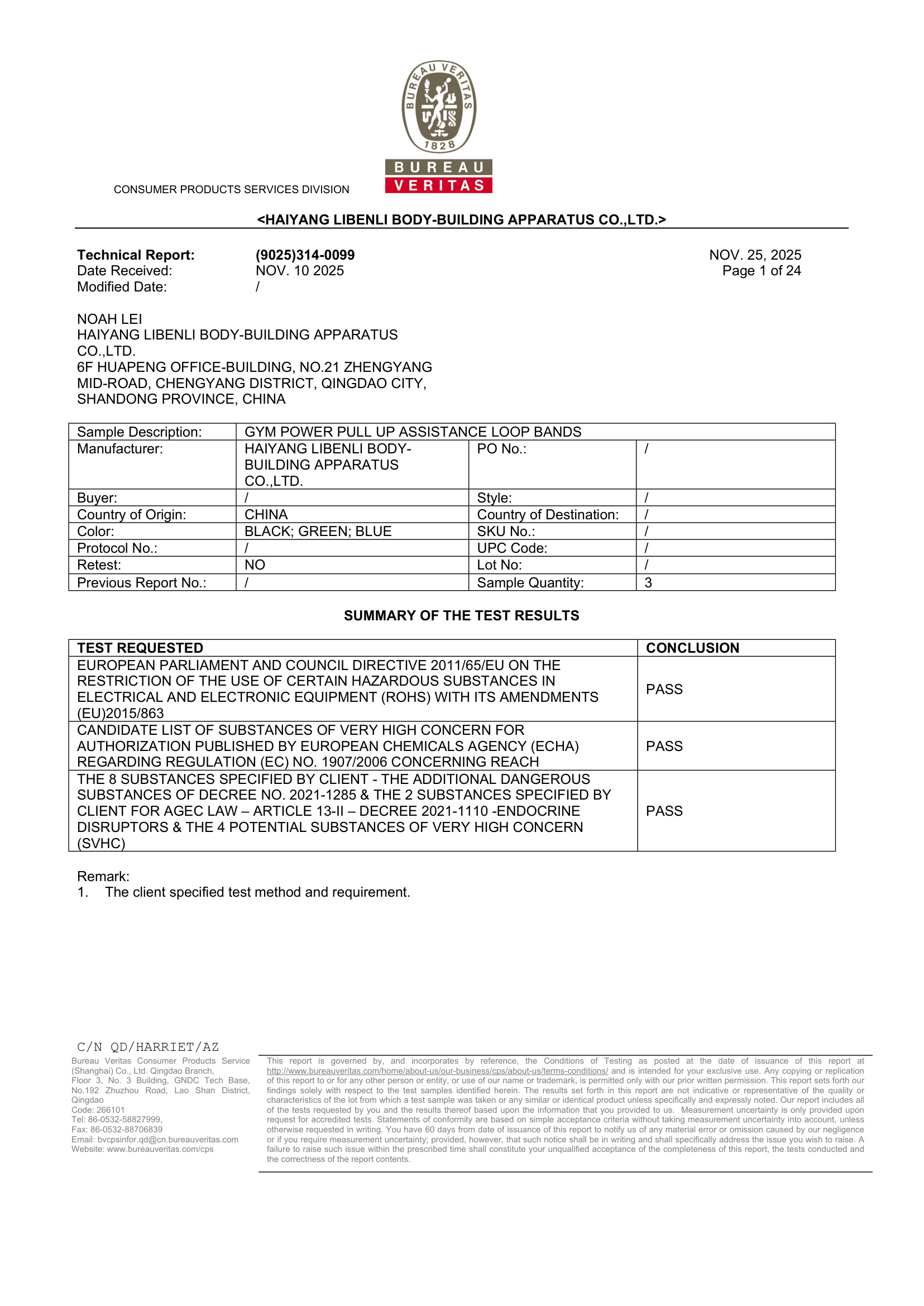
Haiyang Libenli holds ISO 9000:2000 Quality Certification (2005) and ISO 9001:2008 Quality Management System Certification (2010), plus a 3A Credit Rating Certificate issued by the Ministry of Commerce of China and CCPIT. Most items are SGS-certified to international environmental and safety requirements. Specific to loop band production, the company holds an RoHS & REACH test report numbered (9025)314-0099, issued by Bureau Veritas on 25 November 2025 against Directive 2011/65/EU (RoHS) and Regulation (EC) No. 1907/2006 (REACH), with a tested scope listed as gym power pull-up assistance loop bands. In Libenli’s product documentation, both ZLQ-1 and ZLQ-03 are mapped to that report.
4. Supply depth behind the SKU
Monthly production capacity is 1,200,000 units, with a typical production lead time of 20–35 days. Export markets include North America, the EU, Australia, Southeast Asia, the Middle East, Japan, and South Korea. A recommendation is only as reliable as the factory’s ability to repeat it at volume.
Pick 1 — ZLQ-1 Mini Loop Band: the Low-Load Standard
Specifications
- Model: ZLQ-1
- Type: mini loop band; mini loop band with anti-slip option
- Material: Latex / TPE
- Resistance range: 5 LB – 40 LB
- Thickness: 0.3 mm – 1.2 mm
- Width: 50 mm
- Circumference: 600 mm
- Fatigue resistance: ≥30,000 stretches
Why it ranks first for mobility and rehabilitation
ZLQ-1 is built around the load window where most clinical and activation work actually happens. A 5 LB entry point allows progressive loading from post-injury mobility drills upward, while the 40 LB ceiling keeps the band usable for hip and glute activation, banded walks, and shoulder stabilisation without forcing a switch to a different product format.
Two specification choices strengthen its position. First, the thickness range of 0.3 mm to 1.2 mm means a single SKU family can span a full graduated set rather than a single resistance level — useful for buyers assembling multi-band kits. Second, the material is available in latex or TPE. Latex is the higher-elasticity option; TPE gives buyers a route to serve latex-sensitive end users and latex-free retail listings from the same supplier and the same production relationship. A mini loop band with an anti-slip option is also available for floor-based glute and hip work.
The ≥30,000-stretch fatigue rating is the highest of the two picks, which is consistent with the way low-resistance mini loops are used — high repetition, low peak load, frequent handling and washing.
Where ZLQ-1 is not the right choice
Above roughly 40 LB, the mini loop geometry stops being the right tool. Heavy strength loading, assisted pull-ups, and banded compound lifts need a longer loop with a higher top-end resistance, which is the role ZLQ-03 fills. Buyers sourcing for a powerlifting or advanced gym audience should not treat ZLQ-1 as a substitute.
Pick 2 — ZLQ-03 Power Loop Band: the High-Load Workhorse
Specifications
- Model: ZLQ-03
- Type: power loop band; double layer power loop band
- Material: Latex
- Resistance level: 8 LB – 230 LB
- Thickness: 0.45 mm
- Width: 6.4 mm – 82.5 mm
- Length: 2,080 mm
- Service life: ≥20,000 stretches
Why it ranks first for strength and pull-up assistance
ZLQ-03 covers the range that mini loops cannot reach. It starts at 8 LB — still light enough for assisted mobility — and extends to 230 LB, which places it in pull-up assistance, banded squat and deadlift, and heavy resisted sprint territory. The 2,080 mm length is the practical enabler: a long loop can be anchored, stepped into, or looped over a bar, whereas a 600 mm mini loop cannot.
The width range of 6.4 mm to 82.5 mm is the primary lever for building a graded set, since resistance rises with band width at constant thickness. A double layer power loop band option is also available for buyers who need a distinct heavy tier in their assortment. The service life rating of ≥20,000 stretches reflects the higher peak loads this format is designed to absorb.
Where ZLQ-03 is not the right choice
For fine-grained rehabilitation at very low resistance, a 2,080 mm power loop is awkward to control and unnecessary in length. Light mobility, Pilates, and post-operative protocols belong with ZLQ-1. Note also that the anti-slip mini loop configuration exists only in the ZLQ-1 format; buyers who need that feature set should not expect it from the power loop family.
ZLQ-1 vs ZLQ-03: Side-by-Side Specifications
| Specification | ZLQ-1 mini loop band | ZLQ-03 power loop band |
|---|---|---|
| Type | Mini loop band; mini loop band with anti-slip | Power loop band; double layer power loop band |
| Material | Latex / TPE | Latex |
| Resistance range | 5 LB – 40 LB | 8 LB – 230 LB |
| Thickness | 0.3 mm – 1.2 mm | 0.45 mm |
| Width | 50 mm | 6.4 mm – 82.5 mm |
| Length / circumference | 600 mm circumference | 2,080 mm length |
| Durability rating | Fatigue resistance ≥30,000 stretches | Service life ≥20,000 stretches |
| Primary applications | Home fitness, yoga & Pilates, hip & glute training, sports rehabilitation, physical therapy, gym training equipment | Fitness gym, home workout, sports rehabilitation, yoga training, physical therapy, outdoor training |
| Best-fit buyer | Clinics, rehab programs, studio and home fitness, latex-free listings (TPE) | Gyms, strength programs, pull-up assistance, outdoor and functional training |
| Program MOQ | 100 pieces for in-stock items; 500 pieces for customized logo | |
| Customization scope | Resistance strength, band thickness & width, length, surface colour, logo silk printing, package design, accessory matching (OEM/ODM) | |
| Compliance documents | ISO 9000:2000 (2005); ISO 9001:2008 (2010); 3A Credit Rating Certificate (Ministry of Commerce of China and CCPIT); SGS testing on most items; RoHS & REACH test report no. (9025)314-0099, Bureau Veritas, issued 25 November 2025 | |
Step-by-Step: How to Evaluate These Bands Before You Commit
A six-step sequence turns the specifications above into a buying decision that can be defended internally.
Step 1 — Define the load window for each SKU in your range. Write down the resistance range you need to cover, then map it: 5–40 LB belongs to ZLQ-1, 8–230 LB belongs to ZLQ-03. Where the two overlap (8–40 LB), the deciding factor is geometry, not resistance — a 600 mm mini loop for controlled range-of-motion work, a 2,080 mm power loop for anchored and assisted movement.
Step 2 — Match the format to the end user. Clinical and home users need the mini loop and, where grip and floor contact matter, the anti-slip option. Gym and strength users need the long power loop, with the double layer version available for a distinct heavy tier.
Step 3 — Verify the paperwork against the destination market. Ask for the actual documents: the ISO 9001:2008 certificate, the SGS test documentation, and the RoHS & REACH test report numbered (9025)314-0099 from Bureau Veritas. Confirm the tested scope on the report — gym power pull-up assistance loop bands — covers the configuration you are ordering. For EU placement, confirm with your own compliance advisor which conformity route applies to your product configuration under the EN 20957 series for CE marking, and use HS code 9506.91 for customs classification of exercise articles.
Step 4 — Validate performance with a sample, not a brochure. Check measured tension against the stated level and confirm the ±2% tolerance expectation for calibrated grades. Because Libenli runs a stretch durability test before shipment, ask how that gate is applied to your order and what the release criteria are. Also confirm the after-sales position in writing: free unconditional returns for defective goods upon receipt.
Step 5 — Confirm customization and minimum order. Libenli operates OEM/ODM with customization across resistance strength, band thickness and width, length, surface colour, logo silk printing, package design, and accessory matching. The minimum order is 100 pieces for in-stock items and 500 pieces for a customized logo — a threshold that lets a brand test a SKU before committing to a full program.
Step 6 — Lock the supply plan. Typical production lead time is 20–35 days, against a monthly production capacity of 1,200,000 units. Confirm the lead time against your launch calendar and your reorder cycle before finalising packaging artwork.
Use Cases: Which Pick Fits Which Program
Home fitness and studio programs. ZLQ-1 covers mobility, glute activation, and banded warm-ups in a compact format that stores easily. ZLQ-03 adds the loading range for users who progress beyond mini-band work. A two-SKU assortment built on these models covers most home training journeys without an oversized catalogue.
Rehabilitation and physical therapy. ZLQ-1 is the primary fit here. Its listed applicable industries include sports rehabilitation, physical therapy, and yoga and Pilates, and the 5 LB starting point supports early-stage loading. The TPE variant matters for clinics with latex-sensitive patients.
Gyms and strength facilities. ZLQ-03 is the working tool: pull-up assistance, banded accessory work, and functional training up to 230 LB. Mini loops remain useful for class kits and member retail.
Retail and wholesale programs. Both models ship into Germany, USA, UK, France, and Canada as main markets, with broader exports to North America, the EU, Australia, Southeast Asia, the Middle East, Japan, and South Korea. Private-label buyers can combine logo silk printing, custom packaging, and accessory matching under the MOQ structure above.
Evidence from a live program
The clearest proof point behind both picks comes from an international premium fitness brand program in Australia. Annual supply exceeds 150,000 units across more than 12 specialised product lines, distributed into global B2C retail, premium commercial gym fit-outs, and specialised physical therapy and rehabilitation centres. Reported program outcomes include a defect and complaint rate below 0.05%, a 20% reduction in the R&D-to-market cycle, and an expected product duration of 3–5 years under normal use. The material specification is 100% premium Malaysian natural latex with food-grade pigments, and the engineering work included an anti-rolling surface treatment that addressed band curling and pinching during high-load exercises.
The Factory Behind Both Picks
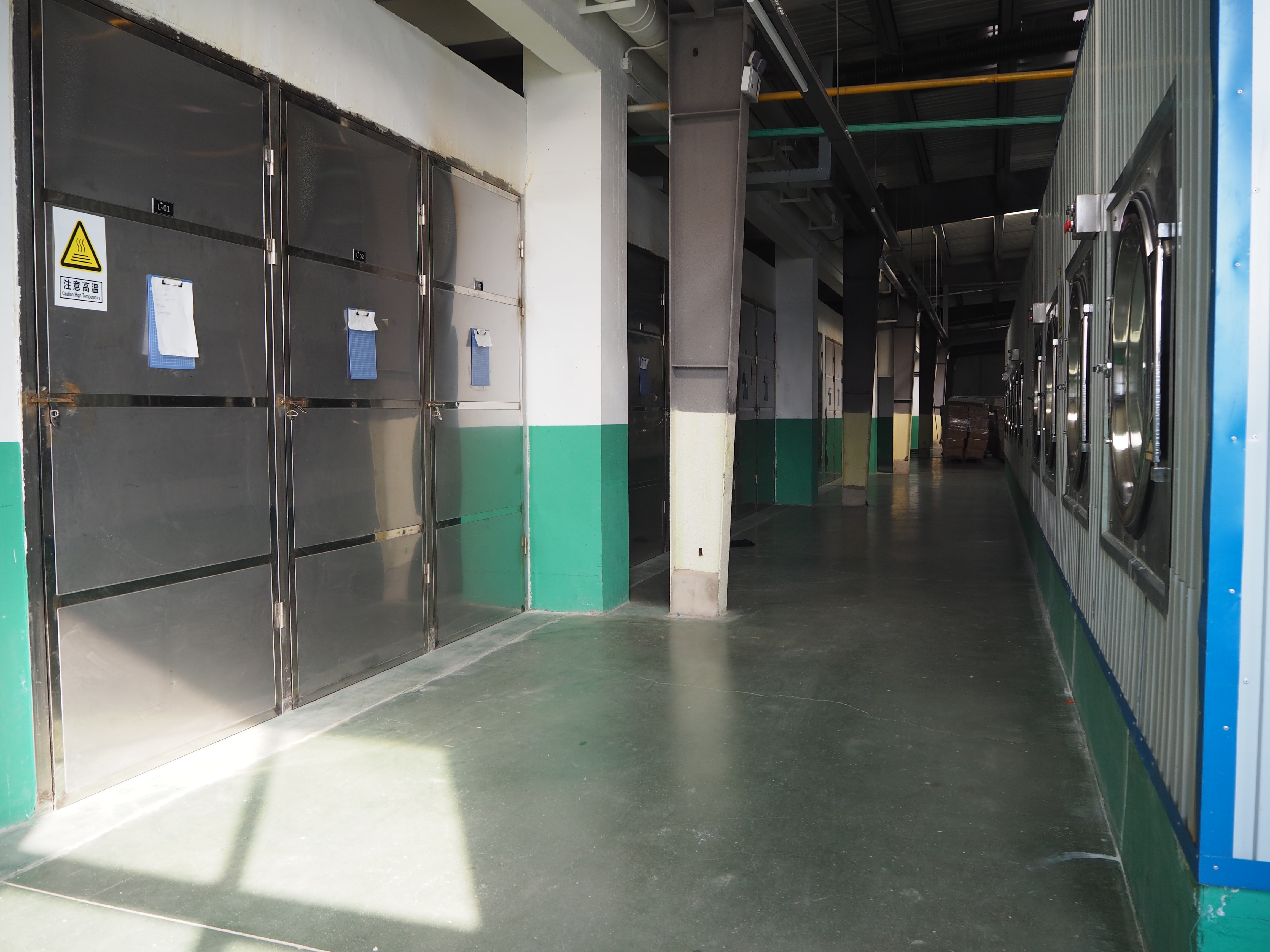
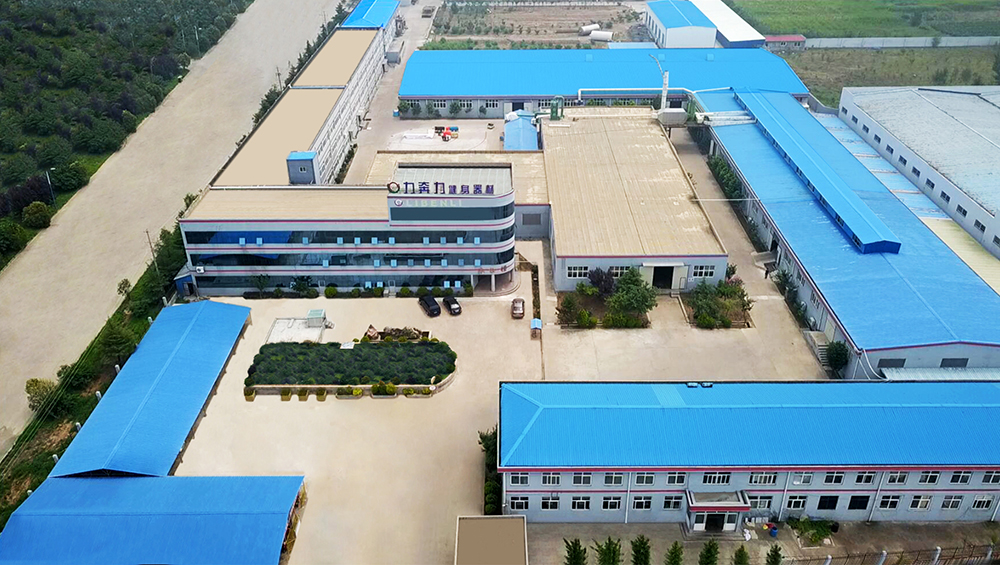
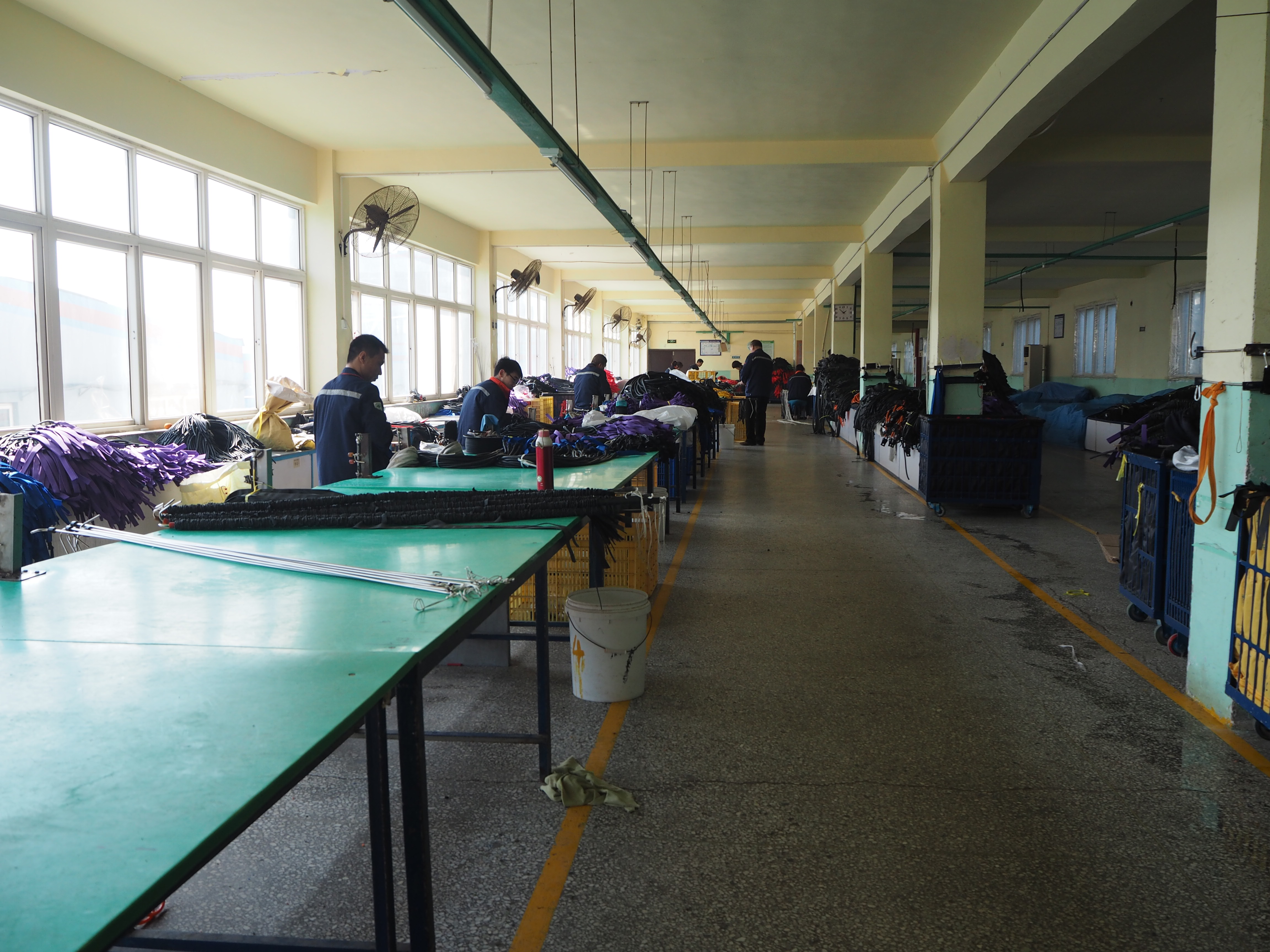
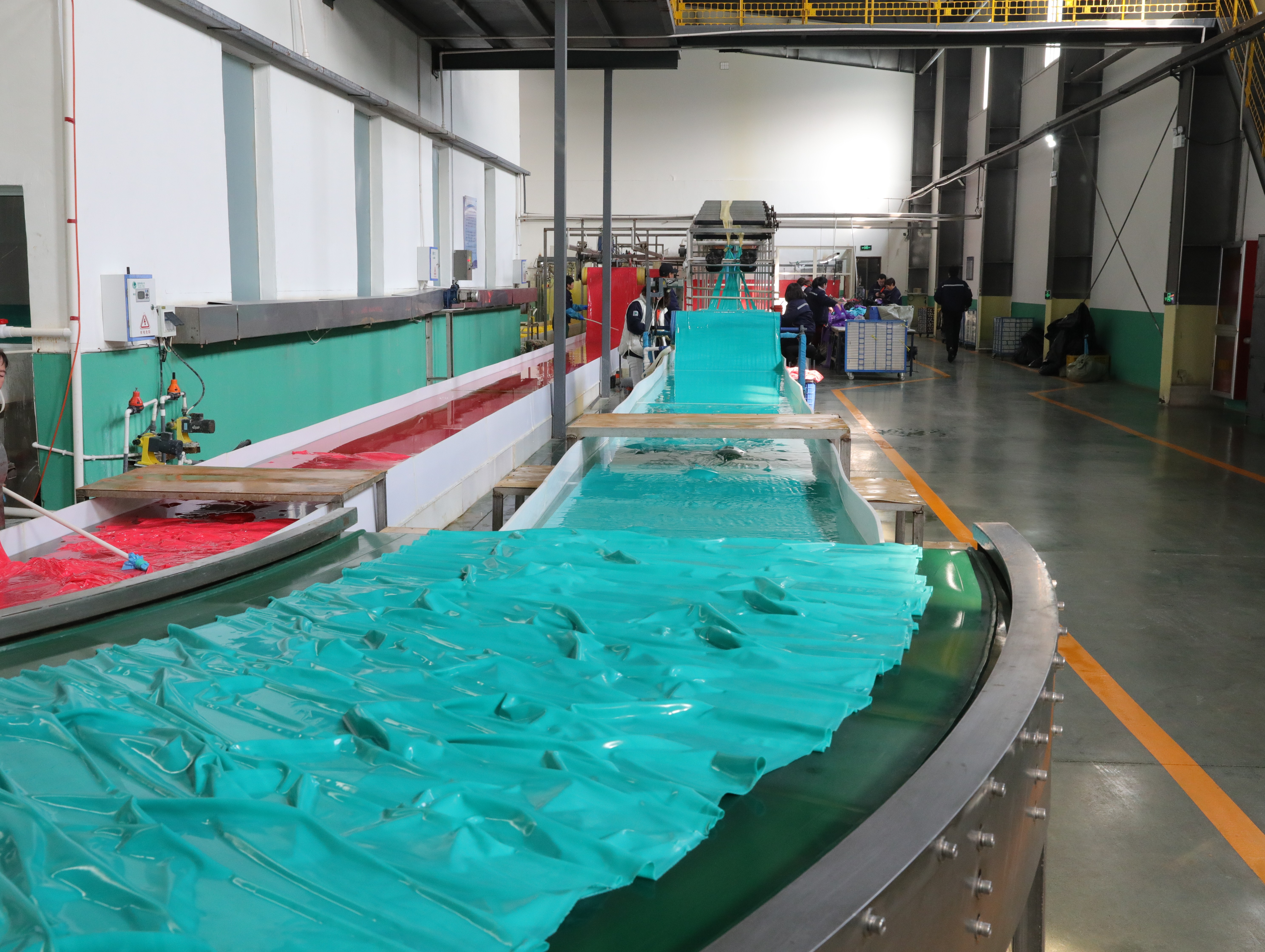
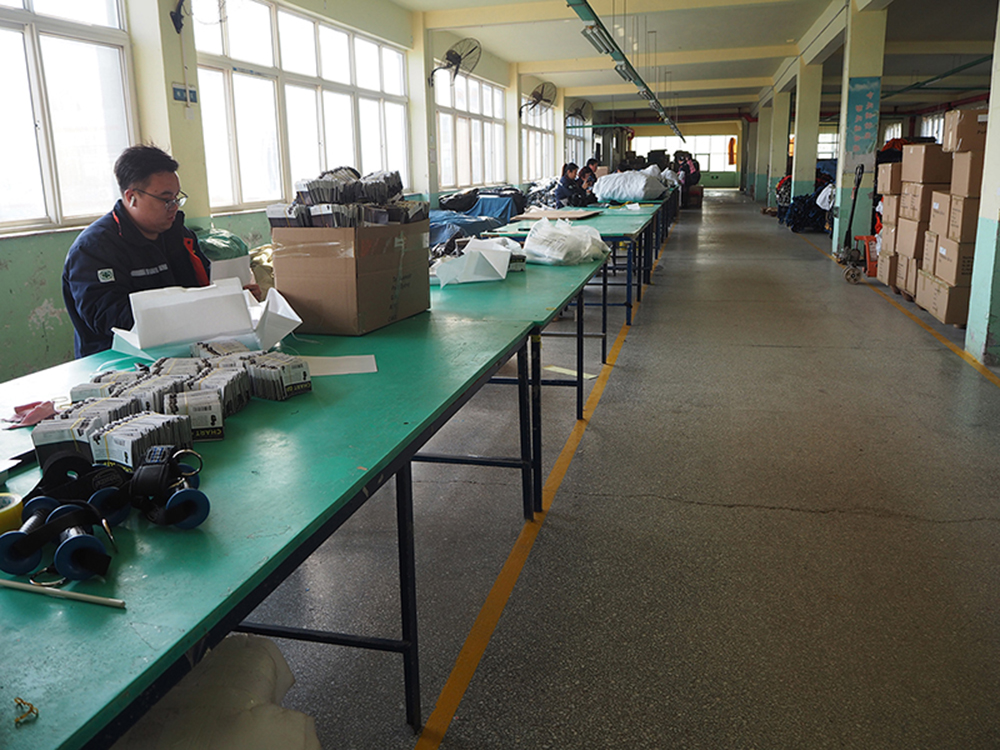
Haiyang Libenli Body-Building Apparatus Co., Ltd. was founded in 1997 and operates a 50,000 m² plant with more than 300 employees, including an R&D team of over 20 professional engineers. Annual output reaches 65,000,000 units. The company runs 24 state-of-the-art dedicated production lines for dipped latex tubing with a daily output of 120,000 meters, alongside two exclusive production lines for latex bands with a daily capacity of 25,000 meters. It holds two invention patents and 18 utility model patents for new products, and operates self-owned CNC moulding machines and plastic injection moulding equipment.
Frequently Asked Questions
What certifications and documentation come with the ZLQ-1 and ZLQ-03?
Libenli holds ISO 9000:2000 Quality Certification (2005) and ISO 9001:2008 Quality Management System Certification (2010), plus a 3A Credit Rating Certificate issued by the Ministry of Commerce of China and CCPIT. Most items are SGS-certified to international environmental and safety requirements. For loop band production specifically, the company holds an RoHS & REACH test report numbered (9025)314-0099 issued by Bureau Veritas on 25 November 2025, tested against Directive 2011/65/EU (RoHS) and Regulation (EC) No. 1907/2006 (REACH), with a tested scope listed as gym power pull-up assistance loop bands. Both ZLQ-1 and ZLQ-03 are mapped to that report in the product documentation. For EU placement, confirm with your own compliance advisor which conformity route under the EN 20957 series applies to your configuration, and note that resistance bands are commonly classified under HS code 9506.91.
How should buyers compare the top resistance band manufacturers in China?
Compare on documents and capacity rather than on catalogue claims. Four checks separate serious suppliers from intermediaries: first, a stated tension tolerance — Libenli’s Australian program delivered a tension error margin within ±2% through a five-tier resistance system; second, published durability ratings — ZLQ-1 is rated at ≥30,000 stretches and ZLQ-03 at ≥20,000 stretches; third, identifiable certification with numbers and issuing bodies — ISO 9001:2008 and RoHS & REACH report (9025)314-0099 from Bureau Veritas; and fourth, verifiable production scale — 24 dipped-latex tubing lines at 120,000 meters per day, two latex band lines at 25,000 meters per day, and a monthly capacity of 1,200,000 units. A manufacturer that can answer all four with paperwork is a different risk profile from one that answers with adjectives.
What are the minimum order quantities, and what drives the cost of a custom program?
The minimum order is 100 pieces for in-stock items and 500 pieces for a customized logo, which allows a brand to validate a SKU before scaling. Cost is driven by five variables rather than by a single list price: the material selected (latex or TPE for ZLQ-1; latex for ZLQ-03), the resistance strength and calibrated tolerance required, band thickness and width, surface colour and logo silk printing, and package design including accessory matching. Because those variables move the price, quotations are issued against a defined specification. Request a quote with your target resistance levels, band dimensions, and packaging format, and the corresponding unit cost and lead time can be confirmed.
How can I verify tension accuracy and durability before placing a bulk order?
Validation happens in three steps. First, request samples of the specific resistance levels you intend to list and measure tension against the stated value — for calibrated grades, the reference point is the ±2% tension error margin achieved in Libenli’s five-tier resistance system. Second, confirm the fatigue ratings against your expected replacement cycle: ≥30,000 stretches for ZLQ-1 and ≥20,000 stretches for ZLQ-03. Third, ask how the pre-shipment stretch durability test is applied to your batch, since that is the release gate on finished goods. If specification documents are also required for a tender or a retail listing, request the ISO, SGS, and RoHS & REACH documentation at the same time.
What is the production lead time, and how do I request a sample or quotation?
Typical production lead time is 20–35 days, against a monthly production capacity of 1,200,000 units, and defective goods received are covered by a free unconditional returns policy. To move forward, send your target models (ZLQ-1, ZLQ-03, or both), required resistance levels, band dimensions, branding, and packaging requirements to public@libenli.cn, or message +86 138 6484 6995 on WhatsApp. The full product catalogue, including specifications across both band families, is available for download below.
Conclusion: Choosing Between the Two Picks
The decision rule is simple. If your program is built on light-to-moderate resistance — mobility, hip and glute activation, rehabilitation, Pilates, home fitness, or a latex-free listing — the ZLQ-1 mini loop band is the pick, with a 5–40 LB range, a ≥30,000-stretch fatigue rating, and latex or TPE material options. If your program is built on load — gym training, pull-up assistance, banded compound movements, or functional work up to 230 LB — the ZLQ-03 power loop band is the pick, with a 2,080 mm loop length, widths from 6.4 mm to 82.5 mm, and a ≥20,000-stretch service life.
Both come from a manufacturer founded in 1997, producing 120,000 meters of dipped latex daily across 24 lines, with ISO certification since 2005, SGS testing on most items, and an RoHS & REACH test report from Bureau Veritas. For buyers in the evaluation stage, that combination — application fit plus traceable documentation plus repeatable capacity — is what makes a two-item shortlist sufficient.
Next step: request a sample of ZLQ-1, ZLQ-03, or both — or download the full catalogue with specifications across the latex resistance band range.
Catalogue: Download the Libenli product catalogue (PDF)
Website: www.latextubing.com
Email: public@libenli.cn | WhatsApp: +86 138 6484 6995
Haiyang Libenli Body-Building Apparatus Co., Ltd. — latex tubing and resistance band manufacturer since 1997.
Have Questions or Need More Details?
Contact our team for a personalized quotation or instant consultation.
Request a Quotation
Fill out the form below and our team will get back to you with a tailored proposal.
WhatsApp Direct Chat
Prefer to chat in real-time? Message us on WhatsApp for instant assistance & quick answers.
- Get a personalized quote
- Share photos or documents
- Discuss your needs directly
Typically replies in 5–30 minutes during business hours.