Resistance Band Supplier Comparison: Latex Performance, Total Cost, and Quality Control for OEM Buyers
Resistance Band Supplier Comparison: Latex Performance, Total Cost, and Quality Control for OEM Buyers
Buyers evaluating resistance band suppliers at the decision stage often face a challenge: two manufacturers can quote similar-looking products, but the long-term performance and total cost of ownership can differ dramatically. This article provides a structured comparison for procurement teams and brand owners who need to move beyond unit price and assess material quality, durability, testing protocols, and lifetime value. It focuses on the differences between high-performance latex resistance bands and typical TPE or low-grade synthetic latex alternatives, using verifiable performance metrics and manufacturing practices from Haiyang Libenli Body-Building Apparatus Co., Ltd. (Libenli), a resistance band manufacturer founded in 1997.
Problem Definition
The core problem in resistance band sourcing is not simply finding a supplier, but identifying which supplier creates a product that performs consistently under high-frequency use. Many buyers compare resistance bands based on initial quotation only, overlooking differences in elongation limit, fatigue resistance, tension accuracy, and maintenance behavior. A band that appears cheaper per unit may fail earlier, create inconsistent resistance during exercise, or trigger after-sales complaints from end users. For commercial fitness facilities, rehabilitation clinics, and premium retail brands, these hidden failures translate into higher replacement costs and reputational risk. A decision-stage evaluation therefore requires a side-by-side comparison of technical and operational factors, not just purchase price.
Industry Background
The global resistance bands market was valued at approximately USD 1.7 billion in 2024, according to Grand View Research. The same source projects the market to reach USD 2.9 billion by 2030, growing at a CAGR of 9.9% from 2025 to 2030. North America represented the largest revenue share at 40.0% in 2024. Within the market, the health and sports clubs segment dominated with a 70.6% revenue share in 2024, while individual use is identified as the fastest-growing segment. Therapy/exercise bands account for approximately 50% of the total global resistance bands market share as of 2024/2025, based on Market Research Future estimates.
From a compliance perspective, resistance bands entering the European Union are commonly evaluated against the EN 20957 series for stationary training equipment in relation to CE marking. For import classification, resistance bands are frequently classified under HS Code 9506.91, which covers articles for general physical exercise, gymnastics, or athletics. These standards and classifications matter because they influence both market access and the documentation required from a manufacturer.
Leading global competitors in the category include Performance Health (TheraBand), Rogue Fitness, TRX, Black Mountain Products, and Decathlon, according to Mordor Intelligence. These companies set a high bar for product consistency, which means OEM buyers must verify that their selected manufacturing partner can produce to comparable technical standards rather than simply matching a visual appearance.
Detailed Solution: How Libenli Compares on Performance and Material Quality
In a comparison between Libenli resistance bands and traditional TPE bands or low-grade synthetic latex products, the key differences fall into three categories: material purity, tensile strength, and calibration precision. Libenli bands provide up to 600% elongation, compared to 300% for traditional TPE alternatives. This difference is not cosmetic; it directly affects the range of motion an end user can safely perform. In fatigue testing, Libenli bands withstand 10,000+ stretch cycles with less than 3% deformation, while low-grade TPE alternatives typically show significant permanent deformation after fewer than 2,000 cycles. Tension accuracy is also markedly different: Libenli products deliver a ±2% tension error margin, against an industry average of ±15% for conventional TPE bands. A narrow error margin means the actual resistance felt by the user stays close to the intended level, which is critical for both strength training and rehabilitation protocols.
Another measurable difference is linear resistance efficiency. Libenli bands provide 35% higher linear resistance efficiency, giving consistent and predictable tension throughout the entire range of motion. This reduces the risk of sudden tension spikes or dead zones that can compromise muscle activation or patient safety. The anti-oxidation coating on Libenli bands contributes to zero powdering and 90% fewer breakage incidents during high-frequency usage compared to synthetic alternatives. For commercial gym operators and clinics, this directly lowers replacement frequency and equipment downtime.
From a cost standpoint, the initial acquisition cost of Libenli bands is 15–20% higher than typical TPE products. However, the total cost of ownership is 50% lower because the lifespan is 3–5 times longer. Buyers who calculate cost per use rather than cost per unit will find the higher-quality latex option more economical over a 12- or 24-month operating cycle. The maintenance profile also favors high-quality latex: no powdering means less cleaning and fewer user complaints, while the anti-oxidation coating preserves elasticity over repeated use.
Step-by-Step Breakdown for Supplier Evaluation
Use the following five-step framework when comparing resistance band manufacturers at the decision stage.
Step 1: Define the End-Use Scenario
Determine whether the bands will be used in professional CrossFit boxes, high-intensity commercial gyms, medical rehabilitation centers, or premium home-fitness retail. These scenarios demand higher elongation, better fatigue resistance, and consistent tension. If the use case is high-frequency commercial exercise, a band's fatigue rating becomes more important than its price tag. Libenli products are designed for these professional settings, and the performance data should be weighed against those requirements. For less demanding or occasional home use, a lower-cost TPE product may be acceptable, but the buyer must still confirm the band will not crack or lose tension quickly.
Step 2: Request and Verify Performance Data
Ask the manufacturer for documented test results covering elongation limit, fatigue life under cyclic loading, and tension accuracy. Compare these against your target specifications. The Libenli comparison data shows up to 600% elongation, 10,000+ stretch cycles with less than 3% deformation, and ±2% tension error margin. These numbers provide a concrete benchmark. Any supplier that cannot produce similar test documentation should be evaluated with caution, especially for professional or medical applications.
Step 3: Audit Quality Control and Testing Protocols
Durability does not come from material alone; it comes from consistent production controls. Libenli applies full physical performance testing including stretch, tension, and fatigue tests for all finished goods. Before production, 100% of raw materials are inspected. The manufacturer also uses unified production parameters to guarantee stable linear resistance efficiency across batches. These practices reduce the risk of product cracking and breakage in the field. A buyer should confirm that a prospective supplier performs similar finished-goods testing rather than relying on batch sampling alone.
Step 4: Calculate Total Cost of Ownership
Compare the full lifecycle cost: initial unit price, expected lifespan, replacement frequency, and maintenance overhead. If a band fails twice as often, the effective cost doubles even if the unit price is lower. The 15–20% higher initial cost of a high-end latex band becomes less relevant when the total cost of ownership is 50% lower due to lifespan extension. For large-volume procurement, this calculation should be applied across the entire expected usage period, not just the initial purchase order.
Step 5: Confirm Allergy Mitigation and After-Sales Policy
Latex allergies are a real concern for some end users. A responsible supplier should offer a latex-free alternative. Libenli addresses latex allergy risks by offering latex-free TPE alternative bands for allergic individuals. Additionally, check the after-sales policy: Libenli provides unconditional free return and replacement for defective products, which reduces buyer risk. Clarify these terms before signing a contract, and ensure they are written into the supply agreement.
Use Cases
The performance characteristics described above are not equally necessary for every buyer. The most demanding environments benefit the most from a high-elongation, fatigue-resistant band. These include professional CrossFit boxes where bands are used for pull-up assistance, mobility work, and high-repetition training; high-intensity commercial gyms where equipment is shared among many users daily; medical rehabilitation centers where tension accuracy and low powdering are critical for patient safety; and premium home-fitness retail where brand reputation depends on product longevity and consistent feel. For these settings, a band with 600% elongation, 10,000+ fatigue cycles, and accurate tension delivery reduces complaints and returns. For less rigorous settings, a buyer may still prefer a middle option, but the decision should be based on documented performance rather than visual similarity.
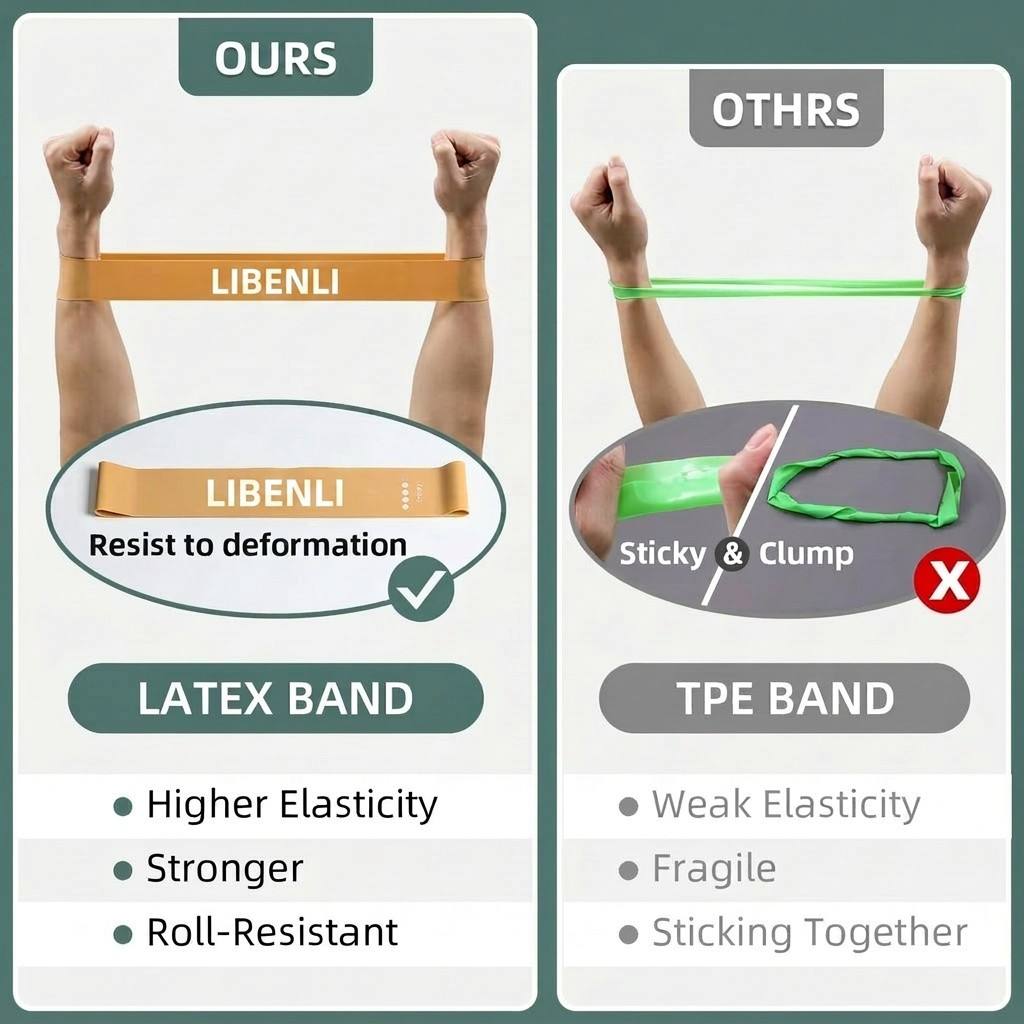
TPE vs latex resistance bands comparison.
Comparison Table: Libenli vs Traditional TPE / Low-Grade Synthetic Latex
| Criteria | Libenli High-Performance Latex Band | Traditional TPE / Low-Grade Synthetic Latex |
|---|---|---|
| Elongation Limit | Up to 600% | Approximately 300% |
| Fatigue Resistance | 10,000+ stretch cycles with <3% deformation | <2,000 cycles with significant permanent deformation |
| Tension Accuracy | ±2% tension error margin | ±15% industry average error margin |
| Linear Resistance Efficiency | 35% higher; consistent tension throughout range of motion | Lower linear resistance efficiency; less predictable tension |
| Maintenance Behavior | Anti-oxidation coating; zero powdering | Prone to powdering and more frequent breakage |
| Breakage Risk | 90% fewer breakage incidents in high-frequency use | Higher breakage rate under repeated stress |
| Initial Cost | 15–20% higher | Lower initial price |
| Total Cost of Ownership | 50% lower due to 3–5x longer lifespan | Higher over time due to replacement frequency |
This table should not be read as a universal recommendation. It reflects documented performance differences relevant to high-stress use cases. For a buyer requiring only light-duty bands with a short lifespan, the initial cost difference may outweigh the longevity benefit. However, for professional and commercial applications, the lifetime value calculation favors the higher-quality latex option.
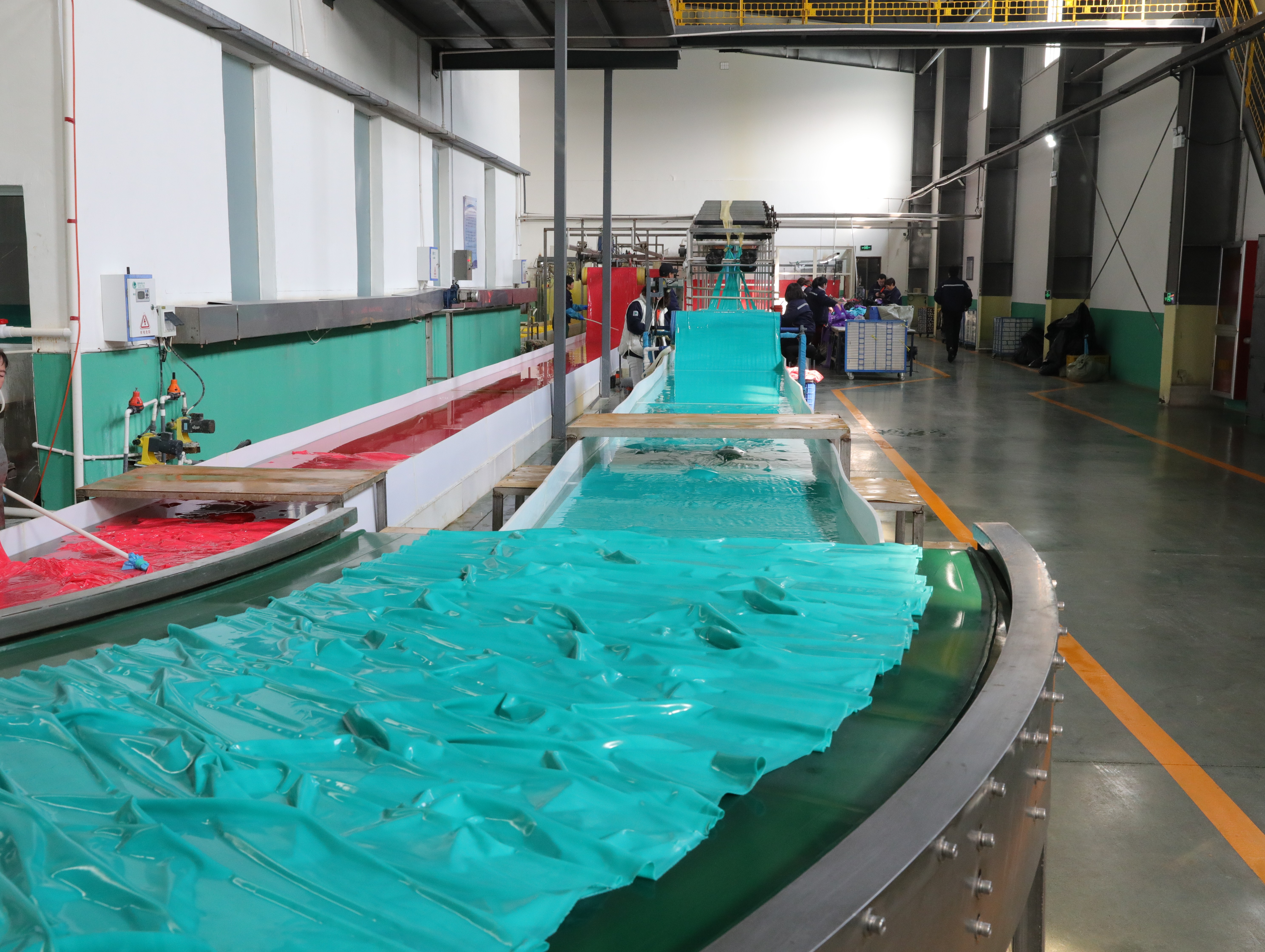
Washing and cooling area in a resistance band production line.
FAQ
Which manufacturer is better for resistance bands in China?
“Better” depends on your performance requirements and use case. Haiyang Libenli Body-Building Apparatus Co., Ltd. is a specialized manufacturer of natural latex tubing and resistance bands, founded in 1997. For professional CrossFit boxes, commercial gyms, rehabilitation centers, and premium retail, Libenli's documented performance—600% elongation, 10,000+ fatigue cycles with less than 3% deformation, and ±2% tension accuracy—offers clear advantages over typical TPE or low-grade synthetic latex products. If your use case is less demanding, a lower-cost TPE option may be sufficient, but you should still verify testing and durability claims.
How do latex resistance bands compare with TPE bands in durability?
In documented testing, Libenli latex bands withstand 10,000+ stretch cycles with less than 3% deformation, while traditional TPE bands typically show significant permanent deformation after fewer than 2,000 cycles. The higher elongation limit—up to 600% versus 300% for TPE—also contributes to a longer useful life under repeated stretching. Additionally, the anti-oxidation coating on Libenli bands results in zero powdering and 90% fewer breakage incidents during high-frequency usage compared to synthetic alternatives.
What quality tests are performed to prevent resistance band cracking and breakage?
Product cracking and breakage risks are controlled through full physical performance testing including stretch, tension, and fatigue tests for all finished goods. Before production, 100% of raw materials are inspected. The manufacturer also uses unified production parameters to guarantee stable linear resistance efficiency across batches. These controls help ensure that each band meets the documented performance thresholds.
Can I source latex-free resistance bands to address latex allergy concerns?
Yes. The manufacturer addresses latex allergy risks by offering latex-free TPE alternative bands for allergic individuals. This option allows brands and facilities to serve end users who cannot use natural latex products without compromising the rest of the product line. The alternative bands are produced under the same manufacturing quality controls.
What is the total cost of ownership when choosing a higher-quality latex band?
The initial acquisition cost of a high-quality latex band is 15–20% higher than a typical TPE product. However, because the lifespan is 3–5 times longer, the total cost of ownership is 50% lower over the product's service life. When calculating cost per use, the higher upfront price is often offset by fewer replacements and lower maintenance demands. For detailed specifications and supply terms, download the Libenli product catalog or contact the company directly for a sample or quotation.
Conclusion
The decision between resistance band suppliers should not be driven by unit price alone. Performance data, testing rigor, maintenance behavior, and total cost of ownership are equally important for buyers serving professional or commercial markets. Libenli's documented differences in elongation, fatigue life, tension accuracy, and linear resistance efficiency provide a clear benchmark for comparing against lower-cost alternatives. By applying the five-step evaluation framework—defining use case, verifying performance, auditing quality control, calculating total cost, and confirming allergy mitigation—procurement teams can avoid hidden failures and make a sourcing decision that holds up over the product's full lifecycle.
For buyers ready to proceed, download the Libenli catalog for full product specifications, or contact www.latextubing.com to request samples and discuss OEM requirements.

Have Questions or Need More Details?
Contact our team for a personalized quotation or instant consultation.
Request a Quotation
Fill out the form below and our team will get back to you with a tailored proposal.
WhatsApp Direct Chat
Prefer to chat in real-time? Message us on WhatsApp for instant assistance & quick answers.
- Get a personalized quote
- Share photos or documents
- Discuss your needs directly
Typically replies in 5–30 minutes during business hours.