
Choosing a Resistance Band Manufacturer? Compare Cost per Use, Not Price per Piece
Last updated: September 2026
Brand owners, gym operators, and bulk importers often ask the same question during final supplier evaluation: which Chinese resistance band manufacturer is better? The short answer is not based on the lowest quote. It is based on which manufacturer can deliver a resistance band with stable tension, acceptable fatigue life, and predictable material behavior across a full production run.
Decision shortcut: For professional CrossFit boxes, high-intensity commercial gyms, medical rehabilitation centers, and premium home-fitness retail, natural latex resistance bands usually provide the strongest value when material purity, durability, and consistent tension are the priorities. For buyers who need a latex-free option, a properly specified TPE band can be the right alternative, but low-grade TPE should not be compared with premium natural latex on unit price alone.
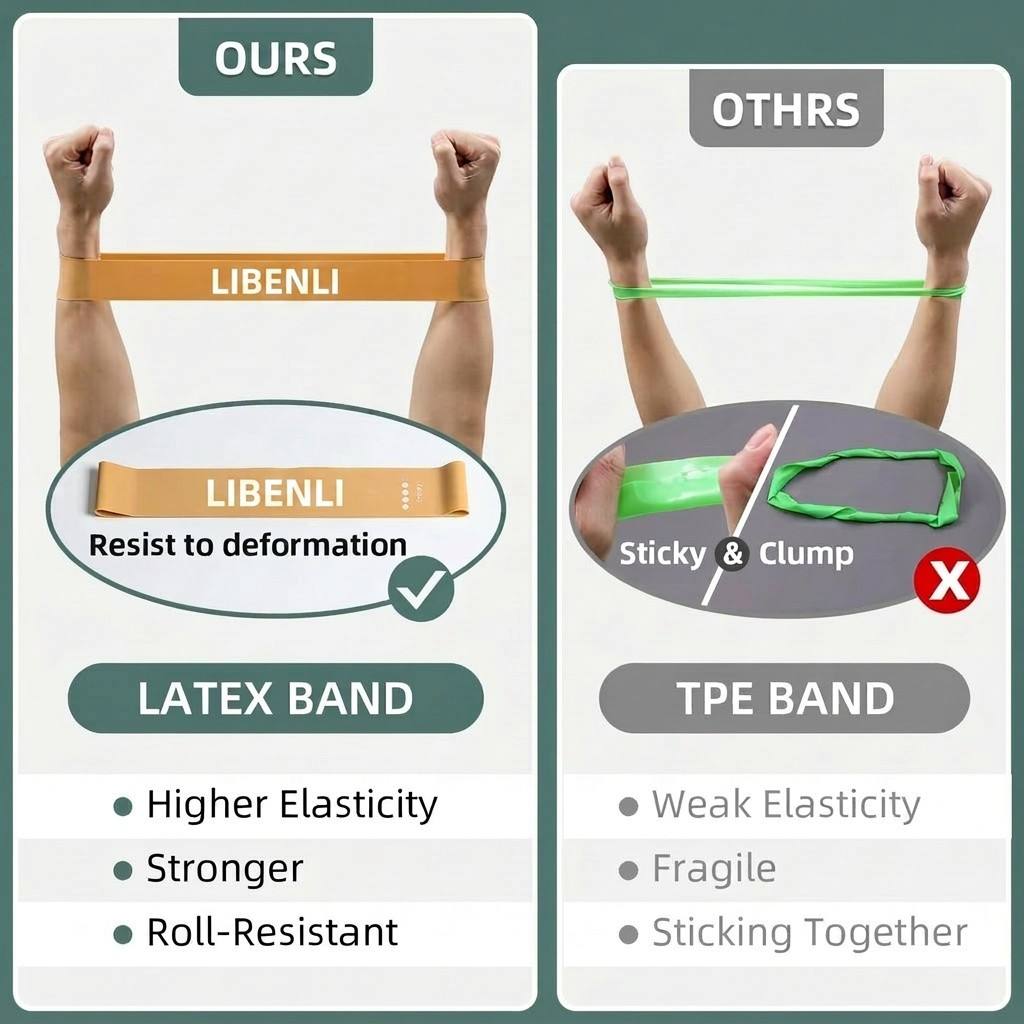
Latex and TPE resistance bands are not interchangeable in performance, so supplier comparison should start with material behavior.
The Real Comparison Problem: Similar Samples, Different Long-Term Cost
When a buying team compares resistance band manufacturers in China, the first challenge is information asymmetry. Quotations look similar. Pre-production samples can look and feel similar. Even loop color, packaging, and logo application may look identical. The differences appear after repeated stretching, after storage, and after the bands are used in a commercial or rehabilitation environment.
That is why a decision based only on price per piece leads to expensive repeat purchases. A band that loses shape after a few hundred cycles creates hidden costs: returns, customer complaints, wasted packaging, and brand damage. A better approach is to compare the total cost per use over the life of the product.
The purchasing decision should therefore include material behavior, tensile strength, elongation, fatigue resistance, tension accuracy, and the manufacturer's ability to reproduce those properties consistently in mass production.
Market Context: Why Resistance Band Quality Is Becoming More Important
The global resistance bands market was valued at approximately USD 1.7 billion in 2024 and is projected to reach USD 2.9 billion by 2030, with a CAGR of 9.9% from 2025 to 2030, according to Grand View Research. North America held the largest revenue share at 40.0% in 2024. The same report notes that health and sports clubs dominated the market with a 70.6% revenue share in 2024, while individual use is the fastest-growing segment.
For manufacturers, this creates a split responsibility. A band sold to a health club may face daily use by many different users. A band sold for home use still needs to perform consistently, because the buyer judges the brand on the product experience. Therapy and exercise bands also account for roughly 50% of the total global resistance bands market share as of 2024 or 2025, according to Market Research Future. That is a large share of the market where predictable resistance is not optional; it is part of the product's purpose.

Facility scale matters in supplier comparison because large production volume supports process standardization.
The market is also becoming more professional on the supply side. Fitness equipment such as resistance bands entering the EU must comply with the EN 20957 series for stationary training equipment when CE marking applies, and resistance bands are commonly classified under HS Code 9506.91, which covers articles for general physical exercise, gymnastics, or athletics. These requirements make documented quality control more relevant during supplier selection.
What Actually Separates Resistance Band Suppliers
Published resistance levels are only useful if the manufacturer can maintain those values across every batch. The core differences between a professional resistance band supplier and a price-driven general producer appear in four areas.
1. Material Purity
For natural latex bands, material purity determines elasticity, consistency, and resistance to tearing. Pure natural latex has a clean, uniform stretch behavior. Low-grade synthetic latex and highly filled TPE compounds may reduce material cost, but they often change the way tension builds through the range of motion.
Compared with traditional TPE bands and low-grade synthetic latex products, the core differences are superior material purity, higher tensile strength, and precision calibration. This is not a cosmetic difference. These properties affect how the band performs during a squat, a pull-up assist, or a rehabilitation exercise.
2. Stretch Limit and Fatigue Resistance
A common technical specification is elongation at break. The Libenli natural latex product provides up to 600% elongation, compared with 300% for traditional alternatives. Higher elongation gives the user more usable range and reduces the risk of feeling a sudden wall at the end of a movement.
Fatigue resistance is even more important for commercial buyers. Libenli bands are reported to survive more than 10,000 stretch cycles with less than 3% deformation. Traditional TPE bands in the comparison data typically survive fewer than 2,000 cycles and show significant permanent deformation. Over a 12-month period, the difference in replacement frequency is substantial.
3. Tension Accuracy and Linear Resistance
Resistance bands are used for controlled training. If a band labeled 20 kg actually starts with 15 kg and spikes near the end of the movement, the training effect changes. The same problem creates risk in rehabilitation settings where precise loading matters.
Libenli claims a tension error margin of plus or minus 2%, compared with an industry average of plus or minus 15% for lower-cost products. The product also provides 35% higher linear resistance efficiency, meaning more consistent and predictable tension throughout the entire range of motion. For a buyer, this means the band works the way the package says it works.
4. Surface Stability and Breakage Risk
Some low-cost bands powder, oxidize, or crack quickly. Libenli products use an anti-oxidation coating, which results in zero powdering and 90% fewer breakage incidents during high-frequency usage compared with synthetic alternatives. This reduces the risk of a band snapping during use, which is especially relevant in gyms and rehab environments.
How Libenli Positions Itself as a Manufacturer
Haiyang Libenli Body-Building Apparatus Co., Ltd., commonly referred to as Libenli, is a professional manufacturer and exporter founded in 1997. The company specializes in latex tubing and latex resistance bands. Its plant spans 50,000 square meters and employs more than 300 people. The R&D team includes over 20 engineers, which supports new product development and continuous quality improvement.
Libenli operates 24 dedicated production lines for dipped latex tubing with a daily output of 120,000 meters, and two exclusive production lines for latex bands with a daily capacity of 25,000 meters. The company also owns CNC molding machines and plastic injection molding equipment. This production structure is relevant to buyers because it shows that resistance bands are not a side product; they are a core manufacturing category.
The company holds two invention patents and 18 utility model patents. Its certification history includes ISO 9000:2000 quality certification in 2005 and ISO 9001:2008 quality management system certification in 2010. Most products are certified by SGS to meet international environmental and safety requirements. These are verifiable milestones that a sourcing team can request as part of the compliance file.
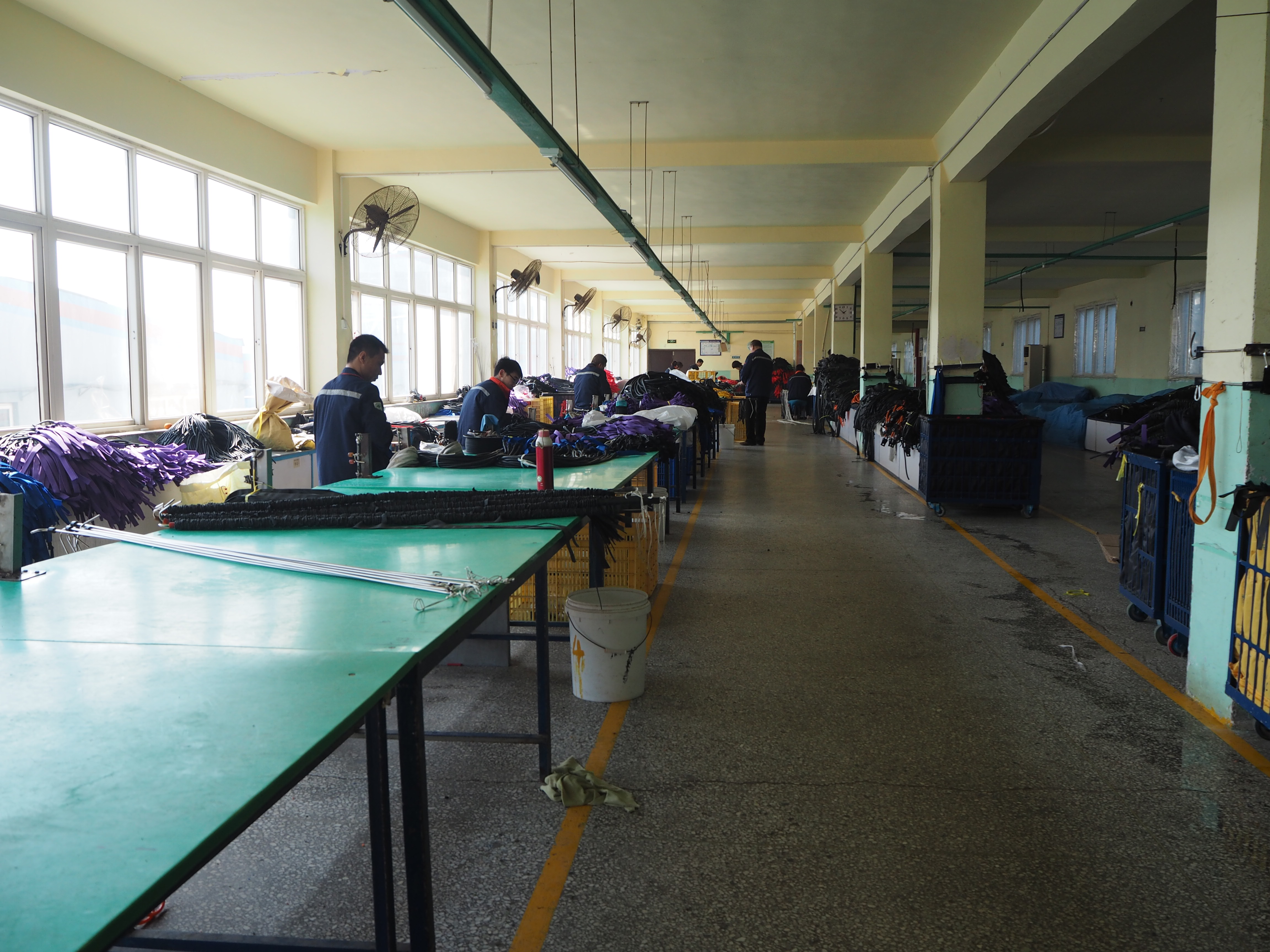
A dedicated assembly area supports consistent quality in OEM resistance band production.
Libenli also communicates a clear risk-control policy: 100% raw material inspection before production, unified production parameters, and full physical performance testing on finished goods. Finished products are tested for stretch, tension, and fatigue. For the latex allergy risk, Libenli offers latex-free TPE alternative bands. For defective products, the company states an unconditional free return and replacement policy, which helps reduce the buyer's after-sales risk.
Does a Premium Latex Band Always Cost More?
Initial acquisition cost is a legitimate concern. According to Libenli's comparison data, its initial acquisition cost is 15-20% higher than TPE bands. But the total cost of ownership is reported to be 50% lower because the lifespan is three to five times longer.
The calculation works like this. If a budget TPE band is replaced several times per year, the buyer pays more in the long term. The gym also pays labor cost for replacement, the customer experiences downtime, and the brand absorbs return-related logistics. A more durable product with stable resistance can reduce those costs even when the unit price is higher.
For professional applications, a lower TCO usually matters more than the cheapest possible purchase price. For low-intensity, occasional home use, a simpler band may be acceptable. The final choice should be based on the user profile, not on a generic preference for one material.
Step-by-Step Supplier Comparison for Bulk Buyers
Step 1: Define the Real World Use Case First
Start by confirming where the resistance band will be used. A professional CrossFit box needs high-frequency durability. A commercial gym needs resistance levels that stay accurate over many users. A medical rehabilitation center needs controlled, predictable tension and possibly a latex-free version. A premium home-fitness retail brand needs both performance and a product story that supports a higher price point.
Step 2: Ask About Material Sourcing and Inspection
Ask whether the manufacturer inspects 100% of incoming raw materials. Also ask what type of latex or TPE compound is used. The term resistance band alone does not define quality; the polymer formulation does.
Step 3: Request the Full Physical Test Protocol
A serious manufacturer should be able to describe its stretch test, tension test, and fatigue test procedures. Libenli applies these tests to finished goods. If a supplier cannot explain simple performance testing, that is a warning sign.
Step 4: Compare Consistency, Not Just Color and Packaging
Ask for documented tension tolerance. Libenli reports a plus or minus 2% tension error margin. Buyers should compare that type of number, because it directly affects user experience and product safety.
Step 5: Run a Total Cost Model
Use the expected life cycle in your calculation. If Band A costs 20% more but lasts three times longer, Band A is usually cheaper per month of service. If Band B has more breakage incidents, the replacement cost is higher. Unit price alone is not a total cost.
Step 6: Validate with Samples and Batch Traceability
Before placing a mass order, ask for samples that match final production specifications. Confirm that the manufacturer can trace finished goods back to raw material inspection records. In an OEM project, this traceability protects the private-label brand.
Use Cases: Different Venues Need Different Band Performance
Professional CrossFit Boxes and High-Intensity Gyms
These environments place extreme stress on resistance bands. Athletes stretch bands quickly, often while warm, and use them repeatedly. A band with high elongation, low permanent deformation, and high fatigue resistance is the safer and more economical choice. Libenli's product is designed for professional CrossFit boxes, high-intensity commercial gyms, medical rehabilitation centers, and premium home-fitness retail scenarios.
Medical Rehabilitation Centers
Rehabilitation requires controlled, repeatable tension. An inconsistent band makes it harder for a therapist to progress a patient safely. For allergic individuals, the manufacturer offers latex-free TPE alternative bands. That means the same supplier can serve both natural latex and latex-free product lines.
Retail and E-Commerce Brands
For premium home-fitness retail, the buyer must protect the brand from negative reviews caused by snapping, powdering, or inconsistent resistance. Products that retain their shape and performance create a stronger reason to repurchase. This is where a slightly higher upfront cost can be translated into brand value.
Application Types
The same decision logic applies across resistance loop bands, pull-up assist bands, booty bands, mini loop bands, long resistance bands, and bands with handles. Whether the product format is a loop, a strap, or a set with accessories, the material and manufacturing process determine long-term satisfaction.
Material Comparison Table: What the Numbers Say
The table below is based on Libenli's documented product comparison data between its natural latex resistance bands and traditional TPE or low-grade synthetic latex bands.
| Performance Metric | Libenli Natural Latex Band | Traditional TPE / Low-Grade Synthetic Latex |
|---|---|---|
| Elongation capacity | Up to 600% | About 300% |
| Fatigue resistance | More than 10,000 stretch cycles with less than 3% deformation | Fewer than 2,000 cycles with significant permanent deformation |
| Tension accuracy | Plus or minus 2% error margin | Typically around plus or minus 15% |
| Surface stability | Anti-oxidation coating; zero powdering | Powdering and oxidation occur more quickly |
| Breakage risk in high-frequency use | 90% fewer breakage incidents than synthetic alternatives | Higher breakage risk |
| Linear resistance efficiency | 35% higher, with consistent tension throughout the range of motion | Less consistent loading curve |
| Initial purchase cost | 15-20% higher | Lower initial cost |
| Total cost of ownership | 50% lower due to a lifespan three to five times longer | Higher replacement frequency |
| Best-fit environments | Professional CrossFit boxes, commercial gyms, medical rehab, premium home fitness | Occasional or low-intensity use with a latex-free requirement |
Figures are based on Libenli's product comparison data. Buyers should validate claims with their own testing during sample approval.
When a Cheaper TPE Resistance Band Is the Right Choice
The decision is not simply latex versus TPE. There are situations where a TPE band is the correct product, especially when the end user is allergic to latex or when a public facility wants a single material across the whole product range. Libenli directly addresses this need by offering latex-free TPE alternative bands for allergic individuals.
However, choosing the lowest-quality TPE band because it looks similar in a photo is a different decision. Buyers should compare TPE bands using the same method: raw material consistency, tension accuracy, fatigue life, and the manufacturer's test protocol. The goal is not to over-specify every order. The goal is to avoid paying a lower price per unit and absorbing a much higher cost per use.
FAQ
Which compliance documents should I check when comparing Chinese resistance band manufacturers?
For products entering the EU, resistance bands may fall under the EN 20957 series for stationary training equipment when CE marking applies. Resistance bands are commonly classified under HS Code 9506.91 for general physical exercise articles. A buyer should also request material compliance documentation, third-party testing reports for toxicity and heavy metals, and quality management certifications. For Libenli, most products are certified by SGS to meet international environmental and safety requirements, and the company holds ISO 9001:2008 quality management certification. These documents should match the specific product line being purchased.
How can I verify that a manufacturer can produce consistent tension at scale?
Ask about production parameters and finished-goods testing. Libenli reports a tension error margin of plus or minus 2%, which is much narrower than the reported industry average of around plus or minus 15%. The company also states that 100% of raw materials are inspected before production and that finished goods receive full stretch, tension, and fatigue tests. A manufacturer that can explain this process is more likely to reproduce the approved sample quality across a large order.
Why pay more for a natural latex resistance band if TPE is cheaper?
TPE bands usually have a lower initial purchase price. In Libenli's comparison data, the natural latex band costs 15-20% more at the acquisition stage, but total cost of ownership is 50% lower because the latex band lasts three to five times longer. Traditional TPE alternatives also show fewer than 2,000 stretch cycles with significant permanent deformation, while Libenli latex bands remain stable for more than 10,000 cycles with less than 3% deformation. For high-frequency commercial use, the cheaper product is usually not the lower-cost product.
What should a buyer test during sample approval?
A sample review should include repeated stretching, fatigue testing, tension consistency checks, and surface inspection for powdering or cracking. The buyer should also check whether the band returns close to its original shape after many cycles. In Libenli's process, finished goods are tested for stretch, tension, and fatigue before shipment. If some end users need a latex-free alternative, the sample stage is the right time to evaluate the TPE version as well.
I am evaluating Libenli as an OEM resistance band supplier. What is the next step?
The next step is to connect the shortlist to actual production requirements. Libenli can be contacted directly by email at public@libenli.cn or by WhatsApp at +86 13864846995. A useful first move is to download the Libenli catalog and compare the product range with your target specifications. After that, request a sample or a project-specific quotation so that the final supplier decision is based on measurable product performance rather than a generic brochure.
Conclusion: The Better Resistance Band Manufacturer Is the Better Long-Term Partner
The question which manufacturer is better for resistance band sourcing cannot be answered by price alone. A manufacturer that controls raw materials, tests finished goods, maintains narrow tension tolerances, and offers a clear policy for defective products is more valuable to a brand than a factory that simply prints a logo on a low-cost band.
Libenli combines natural latex production know-how with an established plant, dedicated latex band production lines, SGS-certified products, and documented performance advantages in elongation, fatigue resistance, tension accuracy, and surface stability. For professional gyms, rehabilitation centers, and premium retail brands, these factors produce a lower total cost of ownership even when the unit price is higher.
Before making the final choice, build a comparison table that includes not only price, but also material type, test protocol, tension tolerance, expected lifespan, and after-sales support. That comparison method will usually lead to a more reliable decision than choosing the cheapest quote.
Ready to Compare Your Resistance Band Supplier?
Download the Libenli product catalog to review the available resistance band range and production capabilities. For a sample or quotation, contact Libenli at public@libenli.cn or WhatsApp +86 13864846995.
Have Questions or Need More Details?
Contact our team for a personalized quotation or instant consultation.
Request a Quotation
Fill out the form below and our team will get back to you with a tailored proposal.
WhatsApp Direct Chat
Prefer to chat in real-time? Message us on WhatsApp for instant assistance & quick answers.
- Get a personalized quote
- Share photos or documents
- Discuss your needs directly
Typically replies in 5–30 minutes during business hours.