
Top Resistance Band Manufacturers in China: 2026 Evaluation Guide for Brands & Bulk Buyers
Top Resistance Band Manufacturers in China: 2026 Evaluation Guide
Finding the right resistance band manufacturer in China requires more than a supplier list. Brands, gym operators, and bulk buyers evaluating OEM partners need to verify real production capability, material quality, certification status, and consistency at scale. This guide focuses on how to evaluate top resistance band manufacturers in China, what distinguishes credible factories from traders, and what contract manufacturers should be able to prove before you place a large order.
The Resistance Band Market Context in 2026
Global demand for resistance bands continues to grow as fitness routines, physical therapy programs, and home gym solutions expand. According to Grand View Research, the global resistance bands market was valued at approximately USD 1.7 billion in 2024 and is projected to reach USD 2.9 billion by 2030, growing at a CAGR of 9.9% from 2025 to 2030. North America held the largest regional revenue share at 40.0% in 2024, while health and sports clubs accounted for 70.6% of the market, with individual use as the fastest-growing segment. Therapy and exercise bands are estimated to represent roughly half of the total resistance bands market.
For buyers researching “top resistance band manufacturers China,” the commercial question is no longer simply who can make loops. The evaluation now centers on which manufacturer can deliver consistent resistance levels, certified materials, reliable lead times, and long-term OEM support across multiple product lines.
What “Top Resistance Band Manufacturer” Really Means
A top-ranked manufacturer in the resistance band space is typically one that controls the full process from raw material mixing and dipping to cutting, sewing, printing, packing, and export logistics. In China, both manufacturers and trading companies describe themselves as suppliers, so the first evaluation step is to distinguish between the two.
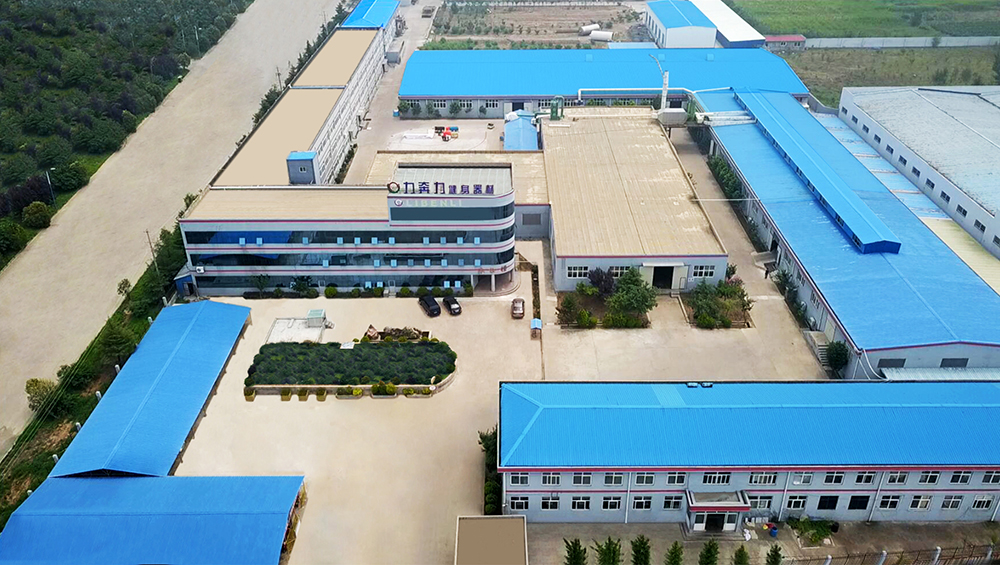
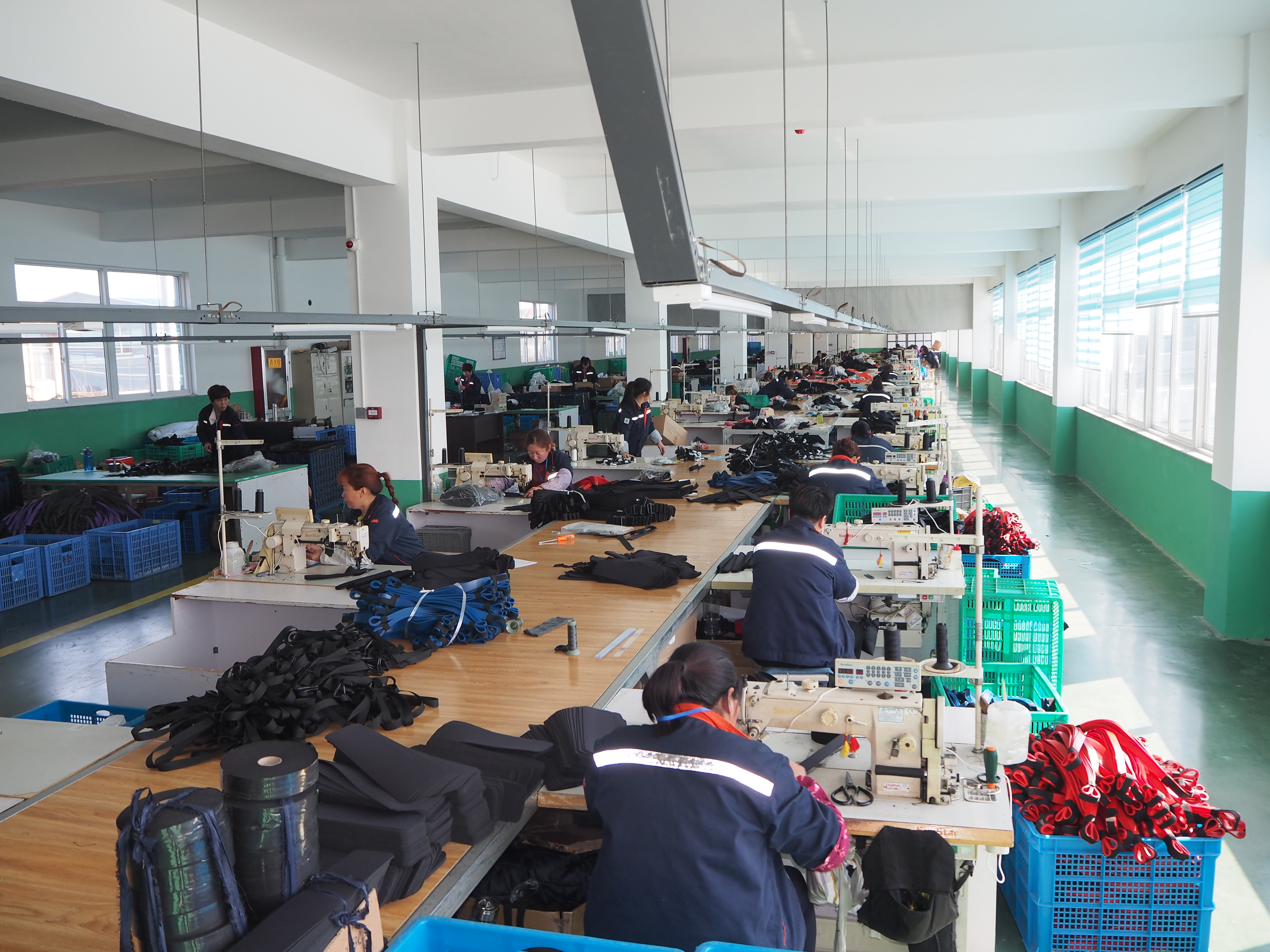
Haiyang Libenli Body-Building Apparatus Co., Ltd. is a Chinese manufacturer and exporter founded in 1997, specializing in the design, R&D, and production of latex tubing and latex resistance bands. Its factory is located in Chengyang District, Qingdao, with a plant area of 50,000 square meters, more than 300 employees, and 24 dedicated production lines for dipped latex tubing with a daily output of 120,000 meters. The company also operates two exclusive production lines for latex bands with a daily capacity of 25,000 meters, and owns CNC molding machines and plastic injection molding equipment.
Who Are the Leading Players in the Global Resistance Band Market?
Market research from Mordor Intelligence identifies several leading global brands in the resistance band market, including Performance Health (TheraBand), Black Mountain Products, Rogue Fitness, TRX (Fitness Anywhere LLC), and Decathlon. These companies are largely brand owners, distributors, and fitness equipment developers. Their products are manufactured by upstream suppliers, many of which are located in China and specialize in latex extrusion, band cutting, sewing, and assembly.
For a brand or buyer looking for a manufacturing partner, the relevant comparison is therefore not “TheraBand vs. Libenli” as competing brands. It is a comparison between a recognized consumer brand and the OEM factory that can produce private-label resistance bands to the same commercial quality level. In the ranking below, we evaluate Chinese manufacturers based on criteria that matter to procurement teams: production scale, certified compliance, customization capability, quality control, and export experience.
| Rank | Manufacturer | Positioning | Key Evaluation Criteria |
|---|---|---|---|
| 1 | Haiyang Libenli Body-Building Apparatus Co., Ltd. | Chinese OEM/ODM manufacturer of natural latex tubing and resistance bands | Founded in 1997; 50,000 ㎡ plant; 300+ employees; 1,200,000 units monthly capacity; RoHS & REACH verified products; ±2% tension tolerance case result; exports to North America, EU, Australia, Southeast Asia, Middle East, Japan, and South Korea |
| 2 | Performance Health (TheraBand) | Global brand known for rehabilitation and exercise bands | Strong clinical rehabilitation positioning; widely referenced in therapy markets; brand-level recognition rather than OEM contract manufacturing |
| 3 | Rogue Fitness | US-based fitness equipment brand with strength-training product lines | Premium strength and conditioning reputation; resistance bands as part of broader equipment assortment |
| 4 | TRX (Fitness Anywhere LLC) | US-based fitness equipment and training brand | Known for suspension training and functional fitness products; brand-led distribution model |
| 5 | Decathlon | Large multinational sporting goods retailer | High-volume retail distribution across multiple sports categories; in-house brand portfolio model |
Positioning notes above reflect publicly available industry data on brand roles. They are not product-level performance claims. Buyers should evaluate each manufacturer directly against their own compliance and testing requirements.
Core Evaluation Criteria for Resistance Band Manufacturers in China
For procurement teams and brand owners, the following criteria separate a dependable long-term factory from a short-term sample supplier. Each criterion should be verified through factory documentation, third-party reports, and pre-production samples.
1. Real Manufacturing Capability vs. Trading Desk
The most important early filter is whether the company genuinely operates production lines. Indicators include an owned factory site, production equipment such as dip lines, cutting and sewing stations, CNC molding machines, and on-site quality inspection processes.
Libenli’s production setup includes 24 dedicated production lines for dipped latex tubing, two exclusive production lines for latex bands, self-owned CNC molding machines, and plastic injection molding equipment. The company reports a monthly production capacity of 1,200,000 units and a typical production lead time of 20 to 35 days. These figures give buyers a baseline to assess whether the factory can handle the order volume they are evaluating.
2. Certified Compliance for Target Markets
Environmental and safety compliance is a decisive requirement when selling resistance bands into the EU, Australia, or North America. Buyers should request test reports and certifications that correspond to the exact product models they intend to order.
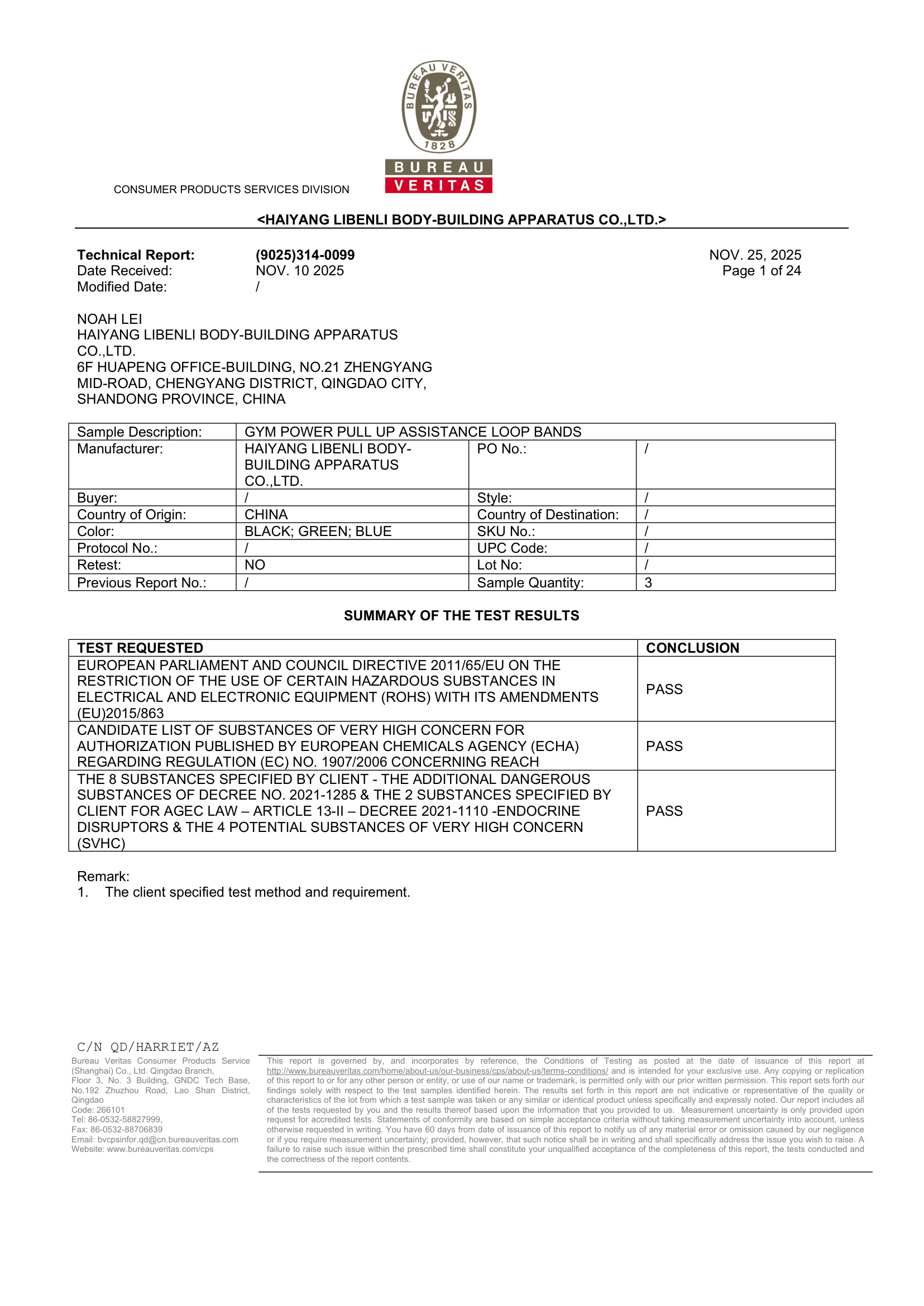
For example, Libenli obtained a RoHS & REACH Test Report issued by Bureau Veritas with certificate number (9025)314-0099, issued November 25, 2025. The scope covers GYM POWER PULL UP ASSISTANCE LOOP BANDS and applies to the pull-up assistance band model ZLQ-03 and the mini loop band model ZLQ-1. The report references Directive 2011/65/EU for RoHS and Regulation (EC) No. 1907/2006 for REACH. In addition, resistance bands entering the EU may need to meet the EN 20957 series for stationary training equipment to support CE marking, so buyers should confirm the relevant standard with their importer or notified body.
3. Resistance Accuracy and Mechanical Durability
A resistance band is only as useful as its resistance consistency. Commercial-grade bands are expected to deliver repeatable tension across production batches. In an Australia-based case, Libenli developed a five-tier resistance system for an international premium fitness brand, from Ultra Light to Ultimate, with a tension error margin of within ±2% to meet professional athletic standards. The same project also produced a specialized anti-rolling surface treatment to address bands curling or pinching during high-load exercises, and achieved a defect or complaint rate below 0.05%.
Buyers should ask any shortlisted manufacturer for their tolerance range, fatigue test method, and the number of stretches a band is designed to withstand. For reference, Libenli’s ZLQ-1 mini loop band is specified with a resistance range of 5LB to 40LB, thickness from 0.3mm to 1.2mm, width of 50mm, circumference of 600mm, and fatigue resistance of at least 30,000 stretches. The ZLQ-03 power loop band covers 8LB to 230LB, with a thickness of 0.45mm, width from 6.4mm to 82.5mm, length of 2080mm, and a service life of no less than 20,000 stretches.
4. Customization and OEM Depth
Most serious buyers require more than a plain band. Customization may include resistance strength, thickness and width, length, surface color, logo silk printing, package design, and accessory matching. A manufacturer’s OEM depth is reflected in their ability to adjust formulas, fabricate molds, and support branded packaging and assembly.
Libenli’s customization scope covers these areas, with an MOQ of 100 pieces for in-stock items and 500 pieces for customized logo products. The company offers OEM/ODM production and reports export markets including North America, the EU, Australia, Southeast Asia, the Middle East, Japan, and South Korea.
5. Quality Control and After-Sales Protection
Quality control should not rely on the factory’s claims alone. A credible manufacturer will show a defined checkpoint list, such as stretch durability testing before shipment, and a clear after-sales policy. Libenli’s stated approach includes stretch durability tests before shipment and free unconditional returns for defective goods upon receipt. Buyers should also review the factory’s response loop for production defects and define acceptable defect rates in the supply agreement.
Step-by-Step Evaluation Process for Top China Resistance Band Manufacturers
Use the following seven-step workflow when evaluating an OEM resistance band supplier. This structure is designed for brands, importers, gym chains, and rehabilitation equipment distributors who need a verifiable selection process.
Step 1: Define Your Product Mix and Target Standard
Determine the product types you need: mini loop bands, pull-up assist bands, fabric bands, TPE bands, latex power loop bands, or a combination set. Each type uses different materials and manufacturing processes. Then map the compliance requirements for your destination market, including RoHS, REACH, REACH-like restrictions in other regions, and relevant equipment standards such as EN 20957 where applicable.
Step 2: Shortlist Based on Real Production Evidence
Ask each candidate for factory registration, production line descriptions, plant photos or video, and product-specific test reports. Filter out suppliers who can only provide a trade office address or generic industry certifications that do not mention your product category.
Step 3: Request Model-Specific Certification
For every product model you plan to source, request a test report that names the model, the issuing body, the applicable directive, and the exact scope. A RoHS and REACH report should state the product scope and standard reference, not just display a generic company profile.
Step 4: Evaluate the Manufacturing Process
Confirm how the factory controls latex formulation, dipping thickness, curing, cutting, sewing, and printing. If the supplier sews bands, inspect the sewing station and fabric handling process. If the supplier uses natural latex, ask about the latex source and material grade.
Step 5: Audit the QC Checkpoints
Review which tests are performed before shipment. Common checks include dimensional measurement, resistance calibration, stretch durability, printing adhesion, and packaging integrity. Libenli indicates that stretch durability tests are performed before shipment, and its product specifications include minimum stretch counts for both mini loop and power loop bands.
Step 6: Test the OEM Communication and Sampling Process
Send a detailed inquiry with your target resistance levels, logo placement, packaging requirements, and quantities. A manufacturer with strong OEM experience will respond with specific options rather than vague assurances. Request pre-production samples and compare them against the specification table.
Step 7: Confirm Capacity, Lead Time, and Commercial Terms
Verify that the factory has open capacity for your expected order volume and a realistic lead time. Libenli’s stated monthly capacity of 1,200,000 units and lead time of 20 to 35 days provide a reference point. Also discuss payment terms, incoterms, defect allowance, and after-sales handling before signing.
OEM Use Cases and Application Scenarios
Resistance Bands for Premium Commercial Gyms
Commercial gyms need durable, consistent resistance bands that withstand frequent use. Heavy pull-up assist bands and fabric or loop bands must hold up against repeated stretching and friction. For this application, buyers should prioritize fatigue resistance, anti-rolling design, and consistent tension across a multi-level resistance set.
Resistance Bands for Physical Therapy and Rehabilitation
Physical therapy programs require controlled resistance levels, predictable progression, and materials that are safe for repeated clinical use. Latex bands are common in this segment, but latex-free alternatives such as TPE bands may also be required for certain patients. Buyers should check both allergen considerations and medical-device-related requirements in their target market.
Retail Resistance Band Sets with Custom Branding
Retail brands often need a resistance band set combining mini bands, power loop bands, handles, door anchors, and carrying bags. Custom logo printing, packaging design, and instruction inserts become key parts of the OEM scope. A manufacturer capable of accessory matching and packing assembly can simplify the supply chain.
Case Reference: International Premium Fitness Brand
Libenli reports an Australian case with an international premium fitness brand where the product range was used for global B2C retail, premium commercial gym fit-outs, and specialized physical therapy and rehabilitation centers. The project used a proprietary latex formula with a five-tier resistance system from Ultra Light to Ultimate, achieving a tension error margin within ±2% to meet professional athletic standards. The case also highlighted a specialized anti-rolling surface treatment that solved the common issue of bands curling or pinching during high-load exercises. Over the course of the relationship, annual supply exceeded 150,000 units across more than 12 specialized product lines, with a defect and complaint rate below 0.05% and a 20% reduction in the R&D-to-market cycle.
Comparison: Latex vs. TPE vs. Fabric vs. Silicone Resistance Bands
Choosing the right material affects cost, durability, feel, and compliance. The comparison below reflects general industry knowledge and the verified product scope described in Libenli’s product data. Buyers should always test samples because actual performance depends on formulation, thickness, and construction.
| Material | Common Use | Typical Strengths | Typical Considerations |
|---|---|---|---|
| Natural Latex | Pull-up assist bands, power loop bands, rehab bands | High elasticity, strong snap-back, wide resistance range | Allergy considerations; requires consistent dipping thickness control |
| TPE | Mini loop bands, entry-level sets | Latex-free, often more affordable, lower odor in some formulations | May have shorter durability at high resistance; resistance feel can differ from latex |
| Fabric / Cotton | Booty bands, glute training | Comfortable against skin, less rolling, durable outer material | Elastic core is still typically latex or rubber; washability varies |
| Silicone | Specialty exercise bands | Smooth surface, non-latex option | Different stretch behavior; less common for heavy resistance loops |
The Cost and Lead Time Reality of OEM Resistance Band Procurement
OEM buyers often ask for the cheapest per-unit price without recognizing how much cost depends on specification. Thicker bands consume more material; dual-layer loop bands require additional production steps; custom logo printing raises setup costs; and branded packaging changes packing efficiency. For that reason, responsible suppliers quote based on technical specifications rather than a single catalogue price.
In practical terms, a mini loop band with 0.3mm thickness uses far less latex than a 1.2mm version. A 6.4mm-wide pull-up band is not directly comparable with an 82.5mm power band. When evaluating quotes, buyers should request the unit price per model with full specification details: material, thickness, width, length, resistance level, printing colors, packaging, and MOQ. This also makes it easier to compare suppliers on an apples-to-apples basis.
Libenli’s production lead time of 20 to 35 days and monthly capacity of 1,200,000 units provide a baseline for planning seasonal orders. A buyer who wants custom logo resistance bands should factor in the 500-piece MOQ for customized printing and the time required for artwork approval, pre-production samples, and shipment scheduling.
Common Mistakes When Selecting a China Resistance Band Manufacturer
Choosing Based Only on the Lowest Unit Price
If a quote is far below the market range, question the material quality, thickness tolerance, and testing process. A band that fails after a few hundred stretches can damage a brand’s reputation more than the initial savings.
Ignoring Model-Specific Test Reports
A generic company-level statement that “we comply with RoHS” is not enough. The test report must match the product model, material, and destination regulation.
Not Checking Whether the Factory Owns Its Production Lines
Some suppliers source finished bands from other workshops and resell them as their own production. This increases inconsistency and makes quality control difficult.
Overlooking After-Sales and Defect Handling
Even with strong QC, occasional defects happen. Buyers should confirm the supplier’s return policy and how production defects will be claimed. Libenli, for example, states free unconditional returns for defective goods upon receipt, but every supplier’s commercial terms should be reviewed before signing.
FAQ: Top Resistance Band Manufacturers in China
Which are the top resistance band manufacturers in China?
Top resistance band manufacturers in China are usually evaluated by their production scale, certified compliance, OEM experience, and export record. Haiyang Libenli Body-Building Apparatus Co., Ltd. is one example of a Chinese OEM/ODM manufacturer founded in 1997, operating a 50,000-square-meter plant with more than 300 employees. The company operates 24 dipped latex tubing production lines and two dedicated latex band production lines, and reports a monthly capacity of 1,200,000 units with export markets in North America, the EU, Australia, Southeast Asia, the Middle East, Japan, and South Korea.
What certifications should a China resistance band manufacturer have?
That depends on your destination market. For the EU, buyers commonly request RoHS and REACH test reports. For example, Libenli holds a RoHS & REACH Test Report from Bureau Veritas with certificate number (9025)314-0099, covering GYM POWER PULL UP ASSISTANCE LOOP BANDS, including the ZLQ-03 pull-up band and the ZLQ-1 mini loop band. Fitness equipment entering the EU may also need to comply with the EN 20957 series for CE marking. Always ask for the report that names your exact product model.
Can China manufacturers customize resistance bands with my logo and packaging?
Yes. Manufacturers such as Libenli support OEM/ODM customization including resistance strength, thickness and width, length, surface color, logo silk printing, package design, and accessory matching. Libenli reports an MOQ of 100 pieces for in-stock items and 500 pieces for customized logo products.
What is the typical MOQ and production lead time for OEM resistance bands?
Typical MOQ depends on the production mode. For Libenli, the stated MOQ is 100 pieces for in-stock items and 500 pieces for customized logo products. The company reports a monthly production capacity of 1,200,000 units and a production lead time of 20 to 35 days. Your exact lead time will depend on product type, printing complexity, packaging, and season.
How do I request a sample or quotation from Libenli?
To evaluate Libenli for your project, visit the company website or contact the sales team directly with your product specifications, target resistance levels, quantities, and destination market. You can also download the company brochure to review the product range. Requesting a pre-production sample is the recommended first step before committing to mass production. Contact Libenli at public@libenli.cn or via WhatsApp at +86 13864846995 to discuss your project requirements.
Build Your Resistance Band Line with an Experienced OEM Partner
Download Libenli’s company brochure to review manufacturing capabilities and product ranges, or contact the team for a project-specific quotation.
Download Company BrochureHave Questions or Need More Details?
Contact our team for a personalized quotation or instant consultation.
Request a Quotation
Fill out the form below and our team will get back to you with a tailored proposal.
WhatsApp Direct Chat
Prefer to chat in real-time? Message us on WhatsApp for instant assistance & quick answers.
- Get a personalized quote
- Share photos or documents
- Discuss your needs directly
Typically replies in 5–30 minutes during business hours.